How Much Profit Should a Rental Property Make Per Month?
There is no universal “good” monthly profit for a rental property. Learn how to calculate real rental property profit, account for expenses and vacancy, and understand what your property actually makes each month.
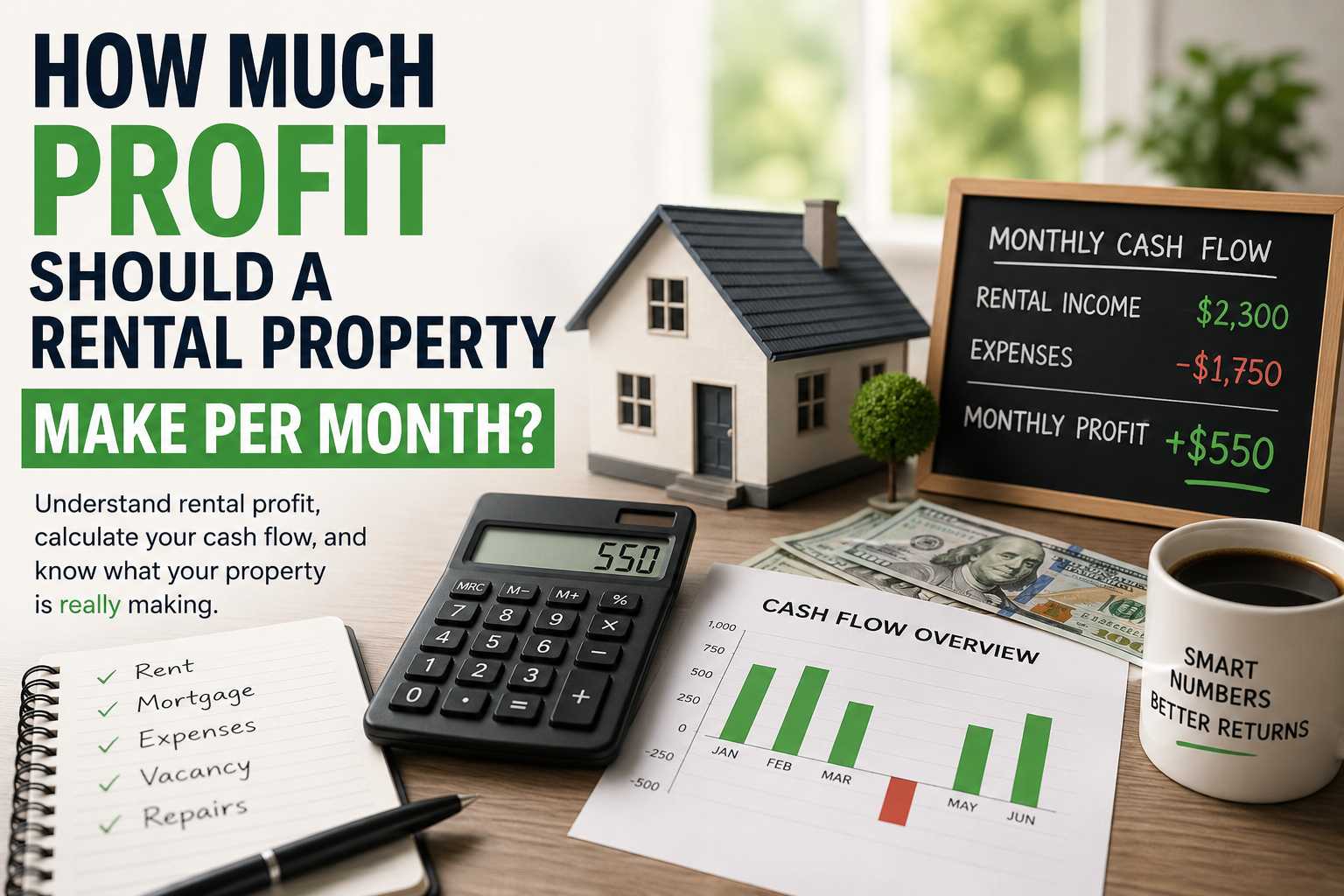
One of the first questions rental property owners ask is:
How much profit should a rental property make per month?
It sounds like there should be a neat answer.
$300? $500? $1,000?
In reality, there is no single monthly profit number that makes a rental property “good.”
A property generating $400 per month could be performing very well in one situation and poorly in another.
The better question is:
After rent comes in and all the property's real costs go out, how much cash am I actually keeping?
That number is your monthly cash flow, and it gives you a much clearer picture of how the property is performing.
What Is Rental Property Profit?
People use the word profit in several different ways.
A landlord might mean:
- rent left after paying the mortgage;
- monthly cash flow after all expenses;
- taxable profit;
- annual return on the money invested;
- increase in the property's value.
For day-to-day property tracking, the most useful version is often monthly cash flow.
The basic calculation is:
Rental Income − Property Expenses = Monthly Cash Flow
If the result is positive, the property generated cash that month.
If the result is negative, the property cost you additional money.
So, How Much Profit Should a Rental Property Make Per Month?
There is no universal target.
A “good” monthly result depends on things such as:
- purchase price;
- rent;
- mortgage size;
- interest rate;
- property taxes;
- insurance;
- maintenance;
- management fees;
- vacancy;
- location;
- amount of cash invested;
- the risk involved.
That is why comparing two properties purely by saying:
“Mine makes $600 per month.”
doesn't tell you very much.
One investor may have put $50,000 into their property.
Another may have invested $250,000.
Those identical $600 monthly cash-flow numbers represent very different investments.
Example: A Property Making $500 Per Month
Imagine a rental property with:
Monthly income
Rent: $2,300
Monthly expenses
Mortgage: $1,150 Management: $180 Insurance: $90 Property taxes / charges: $160 Maintenance: $120 Other recurring costs: $100
Total expenses:
$1,800
Cash flow:
$2,300 − $1,800 = +$500
So the property is generating:
+$500 per month
That sounds good.
And it may be.
But there is still more context to consider.
$500 Per Month Can Mean Very Different Things
Imagine Property A required:
$50,000 of your own cash
and produces:
$500 per month
That is:
$6,000 per year in cash flow
Now imagine Property B also produces:
$500 per month
but required:
$200,000 of your cash
The monthly profit is identical.
The investment is not.
This is why a target such as:
“Every rental should make at least $500 per month”
can be misleading.
Monthly cash flow matters, but so does the amount of money, work and risk required to generate it.
What Is Considered Good Rental Cash Flow?
A useful starting point is simply:
Positive cash flow is better than negative cash flow, all else being equal.
But “good rental cash flow” depends on your strategy.
A landlord focused on dependable monthly income may care heavily about cash flow.
Another investor may accept lower monthly cash flow because they are pursuing a different strategy.
The important thing is to avoid choosing an arbitrary number and assuming every property should hit it.
Instead, ask:
- Is the property consistently cash-flow positive?
- Are the numbers improving or deteriorating?
- Is the cash flow enough for the capital I invested?
- Can the property absorb unexpected repairs?
- What happens when it sits vacant?
- Is one property performing substantially worse than the others?
Those questions are much more useful than chasing a universal monthly-profit target.
Don't Forget Vacancy
A property may look wonderfully profitable if you assume it is occupied every single month.
Reality occasionally has other plans.
Suppose your property rents for:
$2,000 per month
At full occupancy:
$24,000 annual rental income
But imagine it is vacant for one month.
Actual annual rent:
$22,000
Your average monthly rental income across the year becomes roughly:
$1,833
That difference can materially reduce your real annual cash flow.
So when estimating a potential rental property, don't automatically assume twelve perfect months of rent.
Don't Forget Repairs Either
Now imagine your property normally produces:
+$600 per month
Then you need a new appliance costing:
$1,100
That month's cash flow becomes:
-$500
Does that suddenly make the property unprofitable?
Not necessarily.
Rental property performance is lumpy.
One month may contain:
- a boiler repair;
- an appliance replacement;
- plumbing work;
- a vacancy period;
- annual insurance;
- building maintenance.
That is why looking at monthly history is much more informative than judging a property from one isolated month.
A Property Can Have Positive Rent and Still Lose Money
This is an easy trap.
Imagine you collect:
$2,400 rent
and pay:
$1,300 mortgage
At first glance:
“Great, I'm making $1,100.”
Not quite.
You may still have:
- $200 management fee;
- $150 insurance;
- $180 taxes/service charges;
- $120 maintenance;
- $100 utilities;
- $300 unexpected repair.
Suddenly:
$2,400 income
minus:
$2,350 total costs
equals:
+$50 cash flow
The rent minus mortgage calculation looked excellent.
The complete property calculation tells a very different story.
How to Calculate Your Actual Rental Property Monthly Profit
Use this simple process.
Step 1: Add all property income
Include:
- monthly rent;
- parking;
- storage;
- garage income;
- other recurring property income.
Step 2: Add regular costs
Include the costs that genuinely apply to your property, such as:
- mortgage payments;
- insurance;
- property management;
- taxes;
- service charges;
- utilities;
- routine maintenance.
Step 3: Add unexpected expenses
Record repairs and other one-off costs in the month they happen.
This prevents your property from looking artificially perfect.
Step 4: Account for vacancy
If you're tracking an existing property, use the rent you actually received.
If you're evaluating a property before buying it, consider whether your assumptions allow for vacancy.
Step 5: Subtract costs from income
Income − Expenses = Monthly Cash Flow
That gives you a much more useful answer than:
“Rental properties should make X dollars every month.”
Why Monthly History Matters
Imagine your property produced:
| Month | Cash Flow |
|---|---|
| January | +$480 |
| February | +$520 |
| March | +$510 |
| April | +$500 |
| May | -$900 |
| June | +$530 |
If you looked only at May, the property would look terrible.
But perhaps May contained a major repair.
Across several months, you can see the real pattern.
That history helps you answer questions such as:
- Is the property usually profitable?
- Are costs increasing?
- Are repairs becoming more frequent?
- Is rent keeping up with expenses?
- Which property is generating the most cash?
- Which property is quietly dragging down the portfolio?
Should You Focus Only on Monthly Profit?
No.
Monthly cash flow is useful, but it is not the only way to evaluate a rental property.
Investors may also look at:
- cap rate;
- cash-on-cash return;
- total return;
- debt reduction;
- property appreciation.
Each metric answers a different question.
Cash flow is particularly useful because it answers something extremely practical:
What is this property actually doing to my pocket every month?
What About the “1% Rule” and Other Benchmarks?
You may come across rules of thumb telling you what rent or returns a property “should” produce.
These can be useful as rough screening tools.
But they should not replace the actual numbers.
Property markets vary enormously.
Financing varies.
Taxes vary.
Maintenance varies.
A shortcut cannot know what your mortgage costs, whether the building needs repairs or how often the property sits vacant.
Your own cash-flow calculation can.
The Better Question to Ask
Instead of:
How much profit should a rental property make per month?
try asking:
How much does this property actually make after all the costs I really pay?
Then:
Is that return worthwhile for the amount of money and risk involved?
That's a much stronger way to evaluate a rental property.
Calculate Your Rental Property Cash Flow
If you want to check a property's numbers quickly, use Propertira's free Cash Flow Calculator.
Enter the rent and relevant property costs to see how much cash may be left each month.
→ Try the Free Cash Flow Calculator
No bank connection is required.
Track What Your Property Actually Makes With Propertira
A calculator gives you a snapshot.
Rental-property performance changes month after month.
Propertira helps landlords and property investors track:
- rental income;
- mortgage payments;
- recurring expenses;
- unexpected costs;
- monthly cash flow;
- property history;
- portfolio comparisons.
So instead of wondering whether your rental property is making “enough,” you can see what it is actually making over time.
Want to know what your properties really make? Try Propertira.
→ Start tracking your properties for free
- rental property profit
- rental property cash flow
- rental property monthly profit
- good rental cash flow
- landlord finances
- rental income
- rental property expenses
- property investment
- landlord cash flow
- rental property calculator
- property portfolio
- real estate investing
Put this into practice
Use the free calculators with your own figures, or track every property in one place with Propertira.
Propertira provides estimates based on the information you enter. Results are for informational purposes only and are not financial, tax, legal or investment advice.