Net Effective Rent: How to Calculate True Income After Tenant Concessions
Contract rent numbers can be deceiving when concessions are involved. Here is how to calculate your net effective rent and evaluate the true monthly cash-flow impact of tenant incentives.
Net Effective Rent: How to Calculate True Income After Tenant Concessions
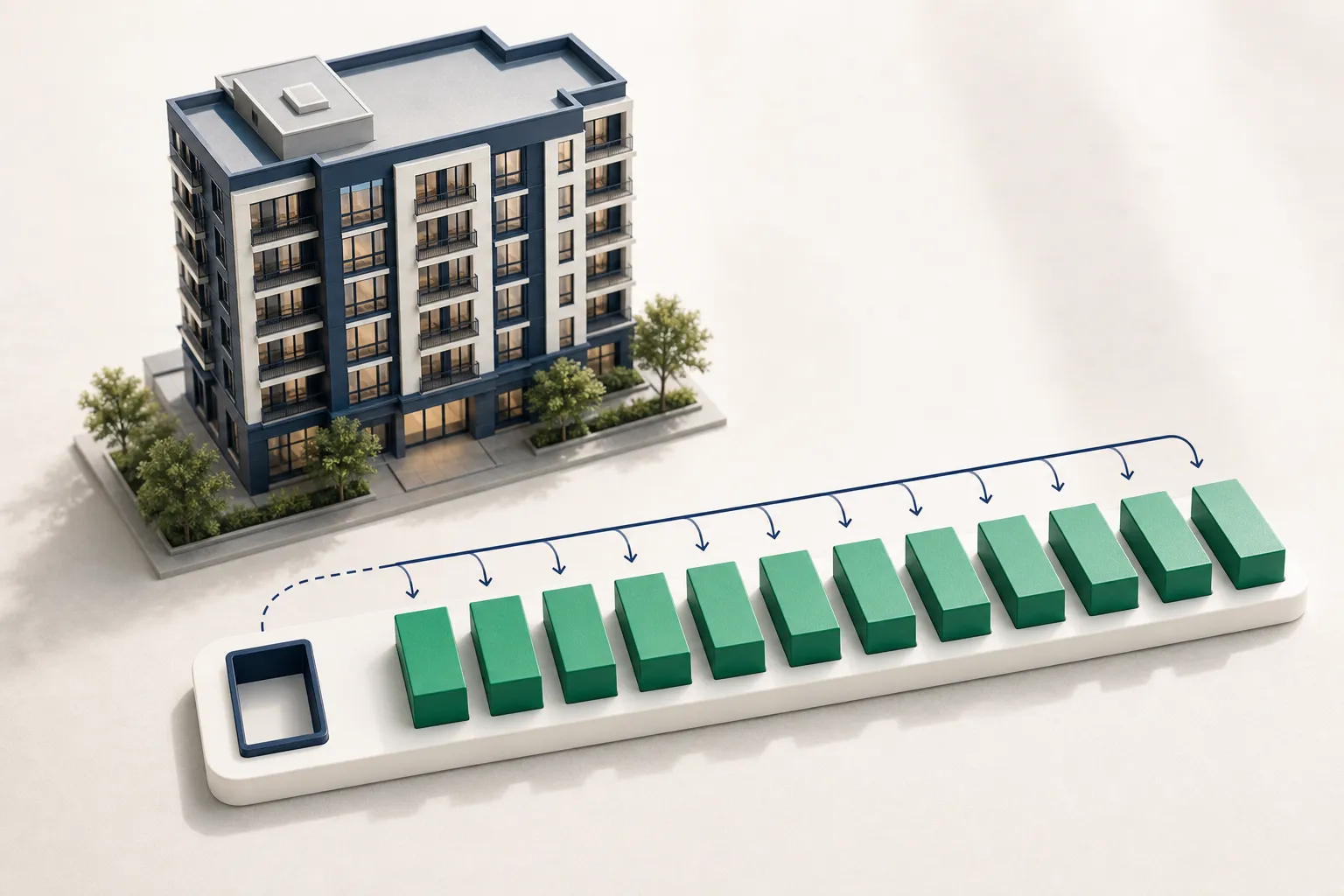
Net effective rent is the actual average monthly revenue you collect from a tenant across a lease term after subtracting all upfront discounts and concessions. While your lease agreement may state a contract rent of $2,400 per month, offering one month of free rent drops your true monthly earnings to $2,200 per month.
Many landlords offer upfront concessions—such as a free month, waived parking fees, or moving credits—to fill an empty unit quickly without lowering their advertised asking price. However, confusing your contract rent with your banked cash flow leads to inaccurate budgeting, distorted profit margins, and unexpected negative cash flow in month one. Here is how to run the net effective rent calculation accurately and evaluate whether concessions actually help or hurt your rental cash flow.
Gross Rent vs. Net Effective Rent: The Core Difference
When evaluating lease income, you deal with two distinct numbers:
- Gross Rent (Contract Rent): The headline monthly dollar amount written into the legal lease agreement and owed by the tenant during non-discounted months.
- Net Effective Rent: The total cash actually collected over the life of the lease divided evenly across every month of that lease term.
Tenants care about net effective rent because it represents their true monthly housing expense. Landlords often prefer gross rent because it maintains a higher published baseline for future rent increases or property valuations. But from a monthly operational standpoint, your mortgage, taxes, and property insurance do not pause when you give away a free month. Your cash flow depends entirely on net effective rent.
If you want to understand how rent levels interact with regular operational costs, you can review our guide on how much rent you should charge.
How to Calculate Net Effective Rent
To calculate net effective rent, take the total rent contracted for the entire term, subtract the total cash value of all concessions, and divide the remaining balance by the total number of months in the lease term.
Net effective rent formula:
Net Effective Rent = (Total Contract Rent - Total Concession Value) / Lease Term in Months
Alternatively, you can express total contract rent as (Contract Monthly Rent x Lease Term in Months). This gives the expanded formula:
Net Effective Rent = ((Contract Monthly Rent x Lease Term in Months) - Total Concession Value) / Lease Term in Months
Let us break down the components:
- Contract Monthly Rent: The stated monthly rent on the lease.
- Lease Term: The duration of the lease in months (commonly 12, 18, or 24 months).
- Total Concessions: The dollar value of free months, gift cards, fee waivers, or upfront cash credits provided to the tenant.
Worked Example 1: 1 Month Free on a 12-Month Lease
Suppose you have a 2-bedroom rental property listed at $2,000 per month. To secure a high-quality tenant quickly after two weeks on the market, you offer the 1st month free on a 12-month lease.
- Contract Monthly Rent: $2,000
- Lease Term: 12 months
- Concession: 1 month free ($2,000 value)
- Total Months Paid: 11 months
Let us calculate the net effective rent:
Total Contract Rent = $2,000 x 12 = $24,000 Total Concessions = $2,000 Total Net Revenue Collected = $24,000 - $2,000 = $22,000
Net Effective Rent = $22,000 / 12 = $1,833.33 per month
In this example, your effective monthly income across the year is $1,833.33—not $2,000. You are taking a $166.67 haircut every month in real terms, even though the tenant pays $2,000 in months 2 through 12.
Worked Example 2: One-Time Upfront Concessions (Moving Credits & Fee Waivers)
Concessions do not always come in whole months of free rent. Small landlords often offer smaller incentives such as moving credits, utility allowances, or waived recurring fees.
Consider a single-family rental with the following terms:
- Contract Monthly Rent: $2,500
- Lease Term: 12 months
- Upfront Concession: $600 moving credit
- Waived Garage Fee: $100 per month for the full year ($1,200 value)
Let us calculate the net income and net effective rent:
Total Contract Rent = $2,500 x 12 = $30,000 Total Concession Value = $600 + $1,200 = $1,800 Total Net Revenue = $30,000 - $1,800 = $28,200
Net Effective Rent = $28,200 / 12 = $2,350 per month
Even though the base contract rent is $2,500, you are operating the property at an effective income level of $2,350 per month.
Concession vs. Lowering the Stated Rent: The Financial Trade-Off
When a rental sits on the market without inquiries, landlords face a strategic choice: offer an upfront concession (like 1 month free) or lower the asking rent directly across all 12 months.
Both paths might yield the exact same total annual cash, but their operational consequences are very different.
| Factor | 1 Month Free Concession | Lower Contract Rent ($1,833/mo) |
|---|---|---|
| Stated Contract Rent | $2,000 / month | $1,833 / month |
| Total Annual Cash Collected | $22,000 | $22,000 |
| Net Effective Monthly Income | $1,833.33 / month | $1,833.33 / month |
| Month 1 Cash Flow | Deeply negative (No rent collected) | Predictable (Standard monthly rent) |
| Lease Renewal Baseline | High ($2,000) | Low ($1,833) |
| Tenant Renewal Friction | Higher risk of tenant sticker shock | Lower risk of turnover |
1. Month 1 Cash-Flow Volatility
If you have fixed monthly operating expenses of $1,600 (mortgage, insurance, property taxes, HOA dues):
- Under a Lower Stated Rent ($1,833/mo): You receive $1,833 in Month 1 and pay $1,600 in expenses. Your Month 1 net cash flow is +$233.
- Under a 1-Month Free Concession: You receive $0 in Month 1 and pay $1,600 in expenses. Your Month 1 net cash flow is -$1,600. You must fund this out of your operating reserves.
If you do not track your monthly numbers closely, a free-rent concession can cause a severe cash crunch in month one, even if the deal looks acceptable on paper. For a full breakdown of evaluating monthly margins, review our guide to calculating rental property cash flow.
2. Lease Renewal Shock
The primary advantage of a concession is setting a higher baseline for the lease renewal. When the 12-month lease ends, you can propose a standard 3% to 5% increase on the $2,000 contract rent ($2,060 to $2,100).
However, this creates a psychological challenge for the tenant. The tenant paid an effective monthly rate of $1,833 in Year 1. A renewal offer of $2,060 feels like a 12.4% rent jump from what they actually paid on average. If the tenant leaves because of this perceived jump, you trigger immediate turnover costs. You can calculate the financial damage of an extra vacancy cycle with our vacancy cost calculator.
How Net Effective Rent Warps Your Net Operating Income (NOI)
Net Operating Income (NOI) measures your property’s operating revenue minus all operating expenses before mortgage payments. Using contract rent instead of net effective rent artificially inflates your NOI on paper.
Let us look at how using contract rent distorts your metrics:
- Property: Single-family rental
- Contract Rent: $3,000 / month ($36,000 / year)
- Concession: 1 month free ($3,000)
- Actual Cash Collected: $33,000 / year
- Annual Operating Expenses (Taxes, Insurance, Repairs): $9,000 / year
If you calculate NOI using Contract Rent:
NOI (Distorted) = $36,000 - $9,000 = $27,000
If you calculate NOI using Net Effective Income:
NOI (Actual) = $33,000 - $9,000 = $24,000
Overstating your NOI by $3,000 gives you an unrealistic picture of your operating cushion. If you are tracking performance or underwriting an asset, always build your income projections around effective income rather than gross contract figures. Learn more about running these figures correctly in our guide on how to calculate NOI for rental property.
When Does Offering a Concession Make Financial Sense?
Concessions are not inherently bad tools. In specific rental scenarios, an upfront discount is financially smarter than letting a unit sit empty or permanently dropping your rate.
1. Off-Peak Vacancies (Winter Months)
If a lease ends in November and tenant demand is low, lowering the rent permanently locks you into a sub-market rate for a full year. Offering 2 weeks of free rent or a $500 move-in bonus can entice immediate applicants while keeping the contract rent at the proper rate for when the lease renews in peak spring or summer market conditions.
2. Signing Longer Lease Terms
If a tenant is willing to sign an 18-month or 24-month lease, an upfront concession of one free month is amortized across a longer timeframe, minimizing the hit to your net effective rent.
For example, 1 free month on a $2,000/month contract over an 18-month lease:
Total Rent = $2,000 x 18 = $36,000 Concession = $2,000 Total Collected = $34,000
Net Effective Rent = $34,000 / 18 = $1,888.89 per month
On a 12-month lease, the net effective rent was $1,833.33. By securing an 18-month term, your effective monthly collection rises by more than $55 per month while locking in occupancy for an extra six months.
3. Immediate Move-Ins to Eliminate Dead Days
If a qualified applicant can move in on the 10th of the month instead of waiting until the 1st of the following month, offering the remaining 20 days prorated or free can secure the lease without losing an entire additional month of carrying costs.
4 Practical Rules for Managing Concessions
If you decide to offer concessions on your properties, use these four operational rules:
- Always document concessions as separate addendums: Your formal lease agreement should clearly state the full contract rent (e.g., "Monthly rent is $2,200"). Add a separate "Concession Agreement" stating: "Landlord grants a one-time rent credit of $2,200 applicable solely to the second month of tenancy, provided the tenant remains in good standing."
- Apply concessions in Month 2, not Month 1: Never give the first month free before collecting move-in funds. Require full security deposit plus the first full month's rent at signing. Apply any free rent credits to Month 2. This ensures the tenant has sufficient capital to move in and validates their payment capacity.
- Include a default clawback clause: If local regulations allow, include terms stating that if the tenant breaches the lease early, the amortized portion of any upfront concession becomes payable immediately. (Note: Legal rules around clawbacks vary widely by jurisdiction; check local landlord-tenant regulations).
- Track cash flow by date received, not contract rent: When tracking property profitability, record the zero-dollar or discounted cash months exactly as they happen. Do not smooth concessions in your accounting records if you need to know whether your bank balance will cover next week's mortgage payment.
Know Your True Monthly Margins
Headline rental rates tell you what your lease says; net effective rent tells you what actually enters your bank account. Whenever you offer a tenant concession, always run the math over the entire lease term to ensure the real monthly return still comfortably clears your operating costs and debt service.
Propertira tracks your actual rental income and real-world expenses property by property. By showing you where every dollar goes and charting your historical cash flow, Propertira helps you know if your rentals actually make money.
- rental income
- cash flow
- rent concessions
- net effective rent
- landlord math
Related guides
- Pet Rent vs Pet Deposit vs Pet Fee: How Each Impacts Rental Cash FlowDiscover how pet rent, pet deposits, and non-refundable pet fees impact your bottom line. We run the numbers across 1-year and 3-year tenancies to find the highest-yielding strategy.
- Effective Gross Income (EGI) for Rental Property: How to Calculate ItEffective Gross Income (EGI) shows the true revenue your rental property generates after factoring in vacancy, lease concessions, and ancillary fees. Learn how to calculate it accurately.
- Economic Vacancy vs Physical Vacancy: How to Measure True Rental Income LossPhysical vacancy only tracks empty days, but economic vacancy reveals the total dollars your rental failed to collect. Here is how to calculate your true revenue loss.
Put this into practice
Use the free calculators with your own figures, or track every property in one place with Propertira.
Propertira provides estimates based on the information you enter. Results are for informational purposes only and are not financial, tax, legal or investment advice.