Rental Property Vacancy Cost: How Much Is an Empty Property Costing You?
Your property doesn't stop costing money when the tenant moves out. See what a vacant rental really costs — and calculate yours with a free vacancy cost calculator.
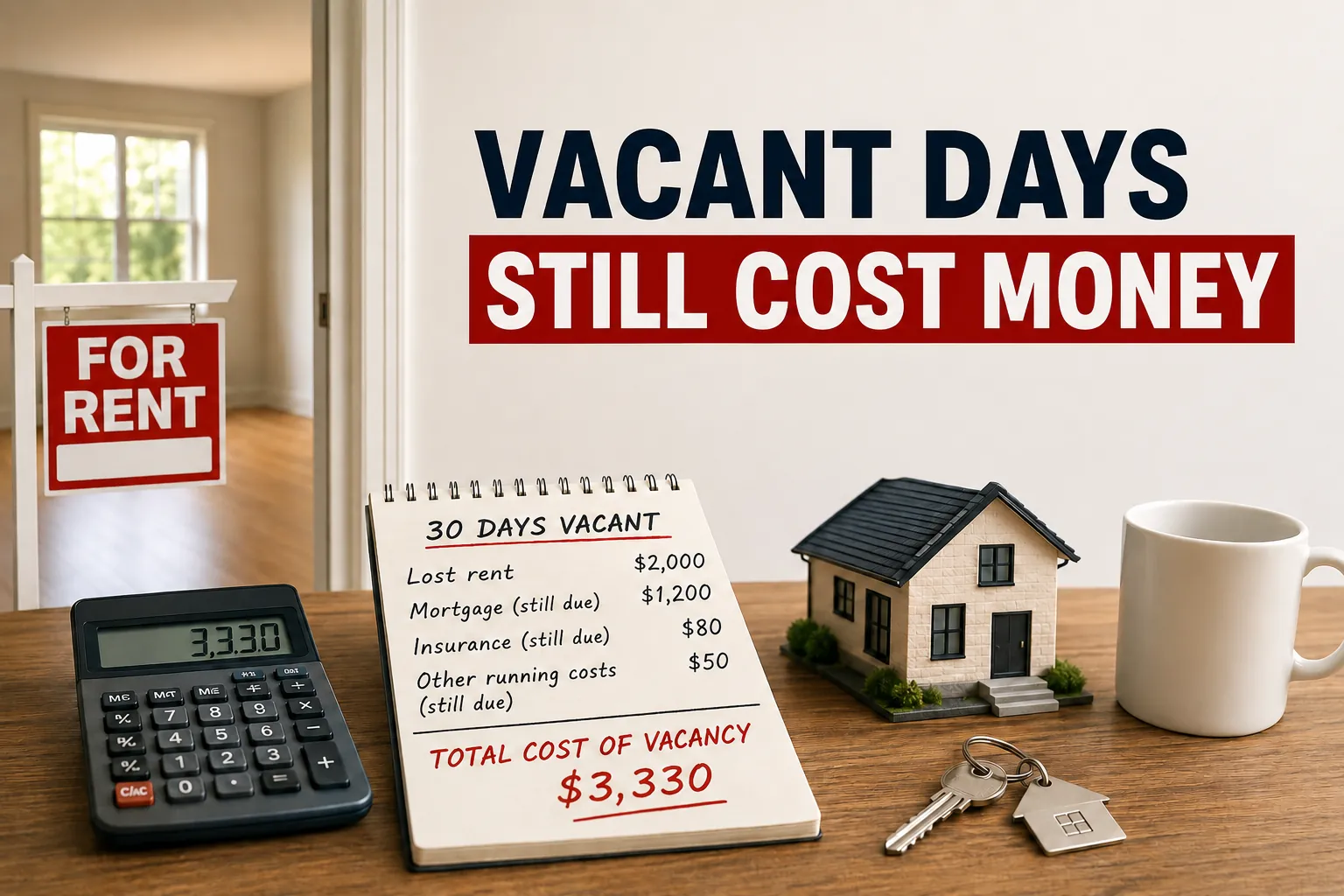
Your property doesn't stop costing money just because the tenant moves out.
The mortgage payment doesn't pause. Insurance doesn't pause. Neither does the service charge, the landlord insurance premium, or whatever else shows up on your running costs list every month. The only thing that stops during a vacancy is the income — which means every vacant day is a day where the costs keep coming and nothing comes in to offset them.
Most landlords have a rough sense that vacancy is expensive. Very few have actually put a number on it. Here's how to do that properly.
The two numbers that make up vacancy cost
Vacancy cost isn't just "the rent I didn't collect." It's that lost rent, plus every cost that kept running while the property sat empty. Miss the second half of that equation and you'll consistently underestimate what an empty unit actually costs you.
Lost rent is the straightforward part: your monthly rent, divided by days in the month, multiplied by the number of vacant days.
Costs that don't pause is the part landlords tend to forget in the moment: mortgage, insurance, and any running costs that are fixed regardless of whether a tenant is in place — property management retainers, service charges, standing utility costs, and so on.
A worked example
Take a property renting for $2,000 a month. Here's what different vacancy lengths actually cost, just in lost rent:
| Vacant days | Lost rent |
|---|---|
| 7 days | ~$467 |
| 14 days | ~$933 |
| 30 days | $2,000 |
That's before anything else. Now add the costs that were still due during that same period — say a $1,200 mortgage payment, $80 in insurance, and $50 in other fixed running costs, all of which are due monthly regardless of occupancy:
| 7 vacant days | 30 vacant days | |
|---|---|---|
| Lost rent | ~$467 | $2,000 |
| Mortgage (still due) | $1,200 | $1,200 |
| Insurance (still due) | $80 | $80 |
| Other running costs (still due) | $50 | $50 |
| Total cost of vacancy | ~$1,797 | $3,330 |
A single week of vacancy on this property costs close to what a full month's rent would have brought in. A full month of vacancy costs more than the rent itself — because the mortgage and other fixed costs kept running the entire time on top of the lost income.
This is the number that actually matters for your cash flow — not "days vacant" as a standalone statistic, but what that vacancy did to your bottom line for the month.
Why "vacancy rate" alone doesn't tell the full story
Rental vacancy rate — the percentage of time a property sits empty over a year — is a useful benchmark for comparing properties or markets. But it's an occupancy statistic, not a cash-flow one. A property with a low vacancy rate can still take a real financial hit from even a short gap between tenants, especially if the fixed costs on that property are high relative to the rent.
Some rental cash-flow tools account for this directly by working vacancy into the calculation itself — deducting lost rent based on vacant days as part of the overall cash-flow picture, rather than tracking occupancy as a separate, disconnected metric. That's the more useful way to think about vacancy: not as a percentage on its own, but as a direct line item in what a property actually nets you.
What actually reduces the cost of vacancy
None of this is about eliminating vacancy entirely — some gap between tenants is normal and, in some cases, unavoidable. What matters is minimizing how long it lasts and knowing the real cost if it runs longer than planned:
- List before the current tenant moves out, where lease terms and local rules allow it, so there's little or no gap between tenancies.
- Price realistically for the local market. An empty property sitting for weeks to chase an extra $50–100 a month is rarely a good trade once the actual cost of those extra vacant days is on the table.
- Keep a maintenance buffer ready. A lot of avoidable vacancy time comes from turnover repairs that could have started the day the previous tenant gave notice, instead of after they left.
- Know your break-even vacancy point. Understanding how many vacant days a property can absorb before it costs you money for the month helps you make faster, calmer decisions when a gap runs longer than expected.
Calculate your own vacancy cost
The example above uses round numbers, but every property is different — different rent, different fixed costs, different vacancy length. The only way to know what an empty unit is actually costing you is to run your own numbers.
[Calculate yours with Propertira's free Vacancy Cost Calculator →](/tools)
It takes your monthly rent and fixed costs and shows you the real cost of vacancy for your property — not just the rent you didn't collect, but the full picture of what kept running while it sat empty. If you're tracking more than one property, that same real cash-flow picture — vacancy included — is exactly what Propertira keeps updated automatically every month.
FAQ
How do you calculate the cost of a vacant rental property? Add up the lost rent for the vacant period (monthly rent ÷ days in month × vacant days) plus every fixed cost that continued during that time — mortgage, insurance, and other running costs. The total is the real cost of the vacancy, not just the missed rent.
What is a good rental vacancy rate? It varies by market, but many landlords aim for a vacancy rate in the low single digits annually. More useful than the percentage itself is knowing the dollar cost of your actual vacant periods, since a low rate can still coincide with a costly individual gap.
Does vacancy cost include the mortgage? Yes. The mortgage payment is due whether or not a tenant is in place, which makes it one of the largest components of the true cost of vacancy alongside the lost rent itself.
How can I reduce vacancy costs on my rental? List early where possible, price realistically for the local market, prepare turnover maintenance in advance, and know your property's break-even vacancy point so you can act quickly if a gap runs longer than planned.
Work it out on your own numbers
Vacancy cost calculator runs this maths for you - enter your rent and costs and see the result straight away. No sign-up needed.\n
- cost of vacant rental property
- landlord cash flow
- rental property vacancy cost
- rental vacancy rate
- vacancy cost calculator
Related guides
- HOA Fees on Rental Property: How Dues and Special Assessments Impact Cash FlowHOA fees directly reduce monthly rental profit, while sudden special assessments can wipe out an entire year of cash flow. Learn how to budget and evaluate association properties accurately.
- Should Landlords Pay Utilities? The Real Impact on Rental Cash FlowDeciding whether to include utilities in the rent directly affects your operating risk and net profit margin. Here is how to evaluate the cash-flow impact.
- Landlord Insurance Costs: What Drives the Premium and How to Budget ItLandlord insurance protects your rental property against damage and liability, but premiums can swing wildly. Here is what drives your policy costs and how to factor them cleanly into monthly cash flow.
Put this into practice
Use the free calculators with your own figures, or track every property in one place with Propertira.
Propertira provides estimates based on the information you enter. Results are for informational purposes only and are not financial, tax, legal or investment advice.