Break-Even Rent Calculator: What Rent Does Your Property Need?
Find the minimum rent your rental property needs to break even. See how mortgage costs, vacancy, repairs and expenses affect cash flow, then calculate your break-even rent.
You can charge $1,800 a month in rent.
Sounds good.
But what if the property costs you $1,950 a month to own?
That is the number that matters.
Before worrying about market rent, rental yield or how much profit a property could produce, there is a more basic question every landlord should be able to answer:
What is the minimum rent I need to charge for this property to stop losing money?
That is your break-even rent.
And fortunately, calculating it is surprisingly simple.
Quick answer: How do you calculate break-even rent?
At its simplest:
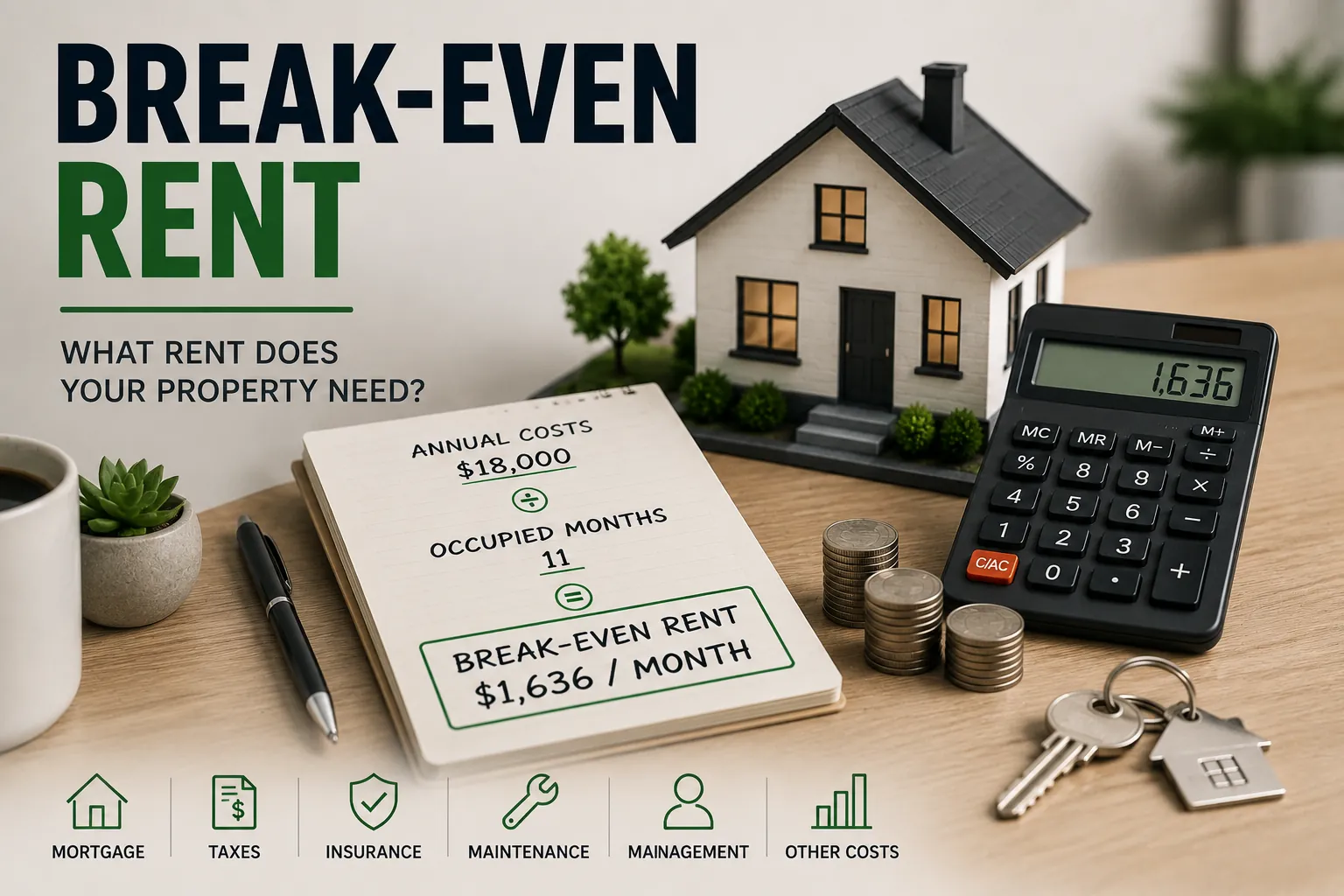
Annual property costs ÷ expected occupied months = break-even monthly rent
For example:
- Annual property costs: $18,000
- Expected occupied months: 11
- Break-even rent: $1,636/month
Charge less than roughly $1,636 and the property loses money.
Charge more and you begin creating positive cash flow.
The important part is making sure your "property costs" actually include everything.
→ Calculate your break-even rent free
Use the Propertira break-even rent calculator to enter your property's income and expenses and see what rent it needs to cover its costs.
What Is Break-Even Rent?
Your break-even rent is the minimum amount of rental income needed to cover the costs of owning and operating a rental property.
At break-even:
Rental income = property expenses
Your cash flow is effectively $0.
You are not necessarily making a profit, but you are no longer funding the property from your own pocket each month.
Imagine a property produces $2,000 in rent but costs $2,200 to own.
Your monthly cash flow is:
$2,000 − $2,200 = −$200
You are effectively paying $200 every month to keep the investment alive.
Raise the rent to $2,200 and you reach break-even.
Raise it to $2,450 and your approximate monthly cash flow becomes:
$2,450 − $2,200 = +$250
Simple.
Except rental properties have one annoying habit: their expenses do not arrive neatly every month.
That is where the calculation gets more interesting.
The Simple Break-Even Rent Formula
If your property is occupied for the entire year, the basic calculation is:
Annual property costs ÷ 12 = minimum monthly rent to break even
Suppose your rental costs are:
| Expense | Annual Cost |
|---|---|
| Mortgage | $13,200 |
| Property tax | $2,400 |
| Insurance | $1,200 |
| Maintenance | $1,500 |
| Other expenses | $900 |
| Total | $19,200 |
Your calculation becomes:
$19,200 ÷ 12 = $1,600
Your approximate break-even rent is $1,600 per month.
If you collect $1,600 every month and your assumptions are correct, the property approximately pays for itself.
But there is a problem.
Properties are not always occupied for 12 months.
Vacancy Changes the Number
Suppose the same property costs $19,200 per year, but you expect it to be occupied for only 11 months.
Now:
$19,200 ÷ 11 = $1,745
Suddenly your break-even rent has increased from:
$1,600 → $1,745
Nothing about the mortgage changed.
Nothing about the property changed.
You simply accounted for one month without rent.
That is why looking only at monthly expenses can create an overly optimistic picture of a rental investment.
Break-even rent with vacancy
You can also calculate this using an expected vacancy rate:
Break-even rent = annual costs ÷ [12 × (1 − vacancy rate)]
For a property costing $19,200 annually with a 5% expected vacancy rate:
$19,200 ÷ [12 × 0.95] = approximately $1,684/month
With 10% vacancy:
$19,200 ÷ [12 × 0.90] = approximately $1,778/month
Same property. Very different result.
Your Break-Even Rent Is Probably Higher Than You Think
This is where landlords often get caught.
The mortgage is obvious.
The smaller costs are quieter.
A $300 repair here. A new appliance there. Insurance renewal. Property management. A vacant month. A plumbing call that somehow manages to happen on a Sunday evening.
Individually, none looks disastrous.
Together, they move your break-even point.
When calculating rental property break even, consider including:
- Mortgage payments
- Property taxes
- Landlord insurance
- Property management fees
- Repairs
- Routine maintenance
- HOA or service charges
- Utilities paid by the landlord
- Licensing or local fees
- Accounting or administrative costs
- Vacancy
- Replacement reserves
- Other recurring property expenses
The goal is not to predict every dollar perfectly.
It is to avoid pretending those dollars do not exist.
The Repair Problem
Suppose your property's regular expenses total:
$1,500/month
You might assume:
Great. Anything above $1,500 is profit.
Then the boiler needs replacing.
Or the washing machine dies.
Or you spend $1,800 preparing the property between tenants.
That is why a more realistic break-even calculation can include a reserve for irregular expenses.
Say you expect roughly $1,800 per year in repairs and replacements.
Instead of ignoring them, spread that cost across the year:
$1,800 ÷ 12 = $150/month
Your effective monthly cost becomes:
$1,500 + $150 = $1,650
Your real break-even point was not $1,500.
It was closer to $1,650.
A More Realistic Break-Even Rent Example
Consider a rental property with the following annual costs:
| Cost | Annual Amount |
|---|---|
| Mortgage | $14,400 |
| Property tax | $2,400 |
| Insurance | $1,100 |
| Management | $1,800 |
| Maintenance | $1,500 |
| Repairs reserve | $1,200 |
| Other expenses | $600 |
| Total | $23,000 |
If you expect full occupancy:
$23,000 ÷ 12 = $1,917/month
But suppose you expect approximately one vacant month per year.
Now:
$23,000 ÷ 11 = $2,091/month
That $174 difference matters.
At $1,950 rent, the property initially looks like it covers its monthly costs.
Once vacancy is included, however, it may actually be running at a loss.
This is exactly why a break even rent calculator can be more useful than looking at rent alone.
Break-Even Rent vs Market Rent
There are two completely different questions landlords need to answer:
1. What rent does the market support?
This depends on factors such as:
- Location
- Property size
- Condition
- Amenities
- Local demand
- Comparable rentals
2. What rent does the property financially require?
That depends on:
- Financing
- Taxes
- Insurance
- Maintenance
- Vacancy
- Management
- Other ownership costs
The two numbers do not automatically agree.
Imagine comparable properties rent for around $1,700.
But your property needs $1,950 to break even.
The market does not care that your mortgage is expensive.
That gap is valuable information.
It may mean the property is overleveraged, expenses are too high, the purchase price was too high, or the investment simply does not work under its current assumptions.
Finding that out is far better than discovering it six months after buying.
What If Market Rent Is Below Your Break-Even Rent?
Suppose:
Market rent: $1,750
Break-even rent: $1,950
You have an approximate $200 monthly gap.
Raising rent to $1,950 sounds like the obvious solution, but only if tenants are actually willing to pay it.
If comparable properties rent for substantially less, pushing above the market can create another problem:
higher rent → fewer applicants → longer vacancy → potentially worse cash flow
Instead, inspect the numbers underneath the property.
Can you:
- Reduce management costs?
- Refinance expensive debt?
- Renegotiate insurance?
- Reduce recurring expenses?
- Charge appropriately for parking or storage?
- Improve the property enough to support higher market rent?
- Reduce tenant turnover?
- Improve occupancy?
Sometimes the correct conclusion is simply that the property is underperforming.
That is useful information too.
Break-Even Rent Is Not Your Target Rent
This distinction matters.
Break-even is the floor, not the goal.
If your required rent is $1,700 and you charge exactly $1,700, there is little room for error.
One unexpectedly expensive repair can push the property negative.
A healthier investment usually needs breathing room above break-even.
For example:
Break-even rent: $1,700 Actual rent: $1,950 Approximate margin: $250/month
Now the property has some ability to absorb unexpected costs while still producing cash.
That margin is where the investment starts becoming interesting.
What About Mortgage Principal?
There is one important wrinkle.
Part of a typical mortgage payment may repay principal.
That principal is not technically an operating expense in the same way as insurance or maintenance because it increases your equity in the property.
But if you are asking:
"How much rent must I collect so I don't have to put my own cash into this property every month?"
then using the full mortgage payment in a cash-flow break-even calculation is often the most practical approach.
If you are analysing accounting profit, return on investment or tax treatment, the calculation becomes different.
That is why rental property analysis rarely comes down to one metric.
Cash flow, yield, expenses, vacancy and other financial indicators tell different parts of the same story.
Break-Even Rent vs Cash Flow
Once you know your break-even point, calculating cash flow becomes much easier.
Monthly cash flow:
Monthly rental income − monthly property costs
If:
Rent = $2,100
and:
Average property costs = $1,750
then:
Cash flow = +$350/month
If rent falls to:
$1,600
then:
Cash flow = −$150/month
Your break-even rent sits exactly between those two outcomes.
It is the line separating:
🔴 You funding the property
from
🟢 The property funding itself
What About Multiple Properties?
Break-even analysis becomes even more useful once you own more than one rental.
One property might generate:
+$620/month
Another:
+$310/month
Another:
−$280/month
Your overall portfolio can still appear profitable.
But that does not mean every property is performing well.
A portfolio-level number can hide an individual property that is quietly consuming cash.
That is why it helps to track cash flow property by property, not just as one combined bank balance.
Your strongest rental may otherwise spend years subsidising your weakest one.
How Often Should You Recalculate Break-Even Rent?
Your break-even rent is not permanent.
Recalculate it whenever something meaningful changes, particularly after:
- Mortgage changes
- Property tax increases
- Insurance renewals
- New management fees
- Significant maintenance costs
- Rent changes
- Longer-than-normal vacancies
- Major renovations
- New service charges or HOA fees
It is also useful to check it periodically even when nothing dramatic happens.
Expenses have a sneaky tendency to creep upward one renewal at a time.
A property that produced healthy cash flow three years ago may now be much closer to break-even.
Calculate Your Break-Even Rent
You do not need a complicated spreadsheet.
Start with three questions:
1. How much does the property cost you each year?
Add your mortgage, taxes, insurance, management, maintenance and other ownership costs.
2. How many months of rent do you realistically expect to collect?
Do not automatically assume 12.
Account for expected vacancy.
3. Divide the first number by the second.
Annual property costs ÷ occupied months = approximate break-even monthly rent
That gives you the rent your property needs just to cover itself.
Then compare it with:
Your current rent.
That difference tells you far more than the rent figure alone.
The Number Every Landlord Should Know
Landlords spend a lot of time asking:
"How much rent can I charge?"
A better question often comes first:
"How much rent do I need?"
If a rental needs $1,850 a month to break even and generates $2,200, you have breathing room.
If it needs $1,850 and generates $1,700, you have a problem worth investigating.
And if you do not know the number at all, you are effectively operating the property without knowing where the financial floor is.
→ Calculate your break-even rent free
Use Propertira to compare rent with your property's real costs, test different assumptions and see what happens to your cash flow when the numbers change.
Because the important number is not simply how much rent comes in.
It is how much you actually keep.
Work it out on your own numbers
Break-even rent calculator runs this maths for you - enter your rent and costs and see the result straight away. No sign-up needed.\n
- break even rent calculator
- landlord calculator
- minimum rent to break even
- rental property break even
- rental property cash flow
Related guides
- Pro Forma vs. Actual Cash Flow: How to Spot Gaps in Rental ProjectionsA pro forma shows what a rental property could earn under ideal conditions, while actual cash flow reflects real operating income. Here is how to spot the gap.
- What Is a Good Cash Flow Per Door? How to Benchmark Your RentalsA realistic cash flow per door benchmark ranges from $150 to $350 per month, but only if you factor in vacancy and capital reserves. Here is how to evaluate your portfolio accurately.
- Principal vs Interest: Why Your Mortgage Payment Hides Your Real ReturnA single mortgage payment lumps two entirely different financial events together: an operating borrowing cost and forced equity savings. Here is how to separate them to measure your true rental returns.
Put this into practice
Use the free calculators with your own figures, or track every property in one place with Propertira.
Propertira provides estimates based on the information you enter. Results are for informational purposes only and are not financial, tax, legal or investment advice.