Cap Rate vs Cash Flow: What's the Difference for Rental Properties?
Cap rate and cash flow measure two different sides of a rental property investment. Learn how each works, why a high cap rate does not always mean strong cash flow, and which metric matters most for your goals.
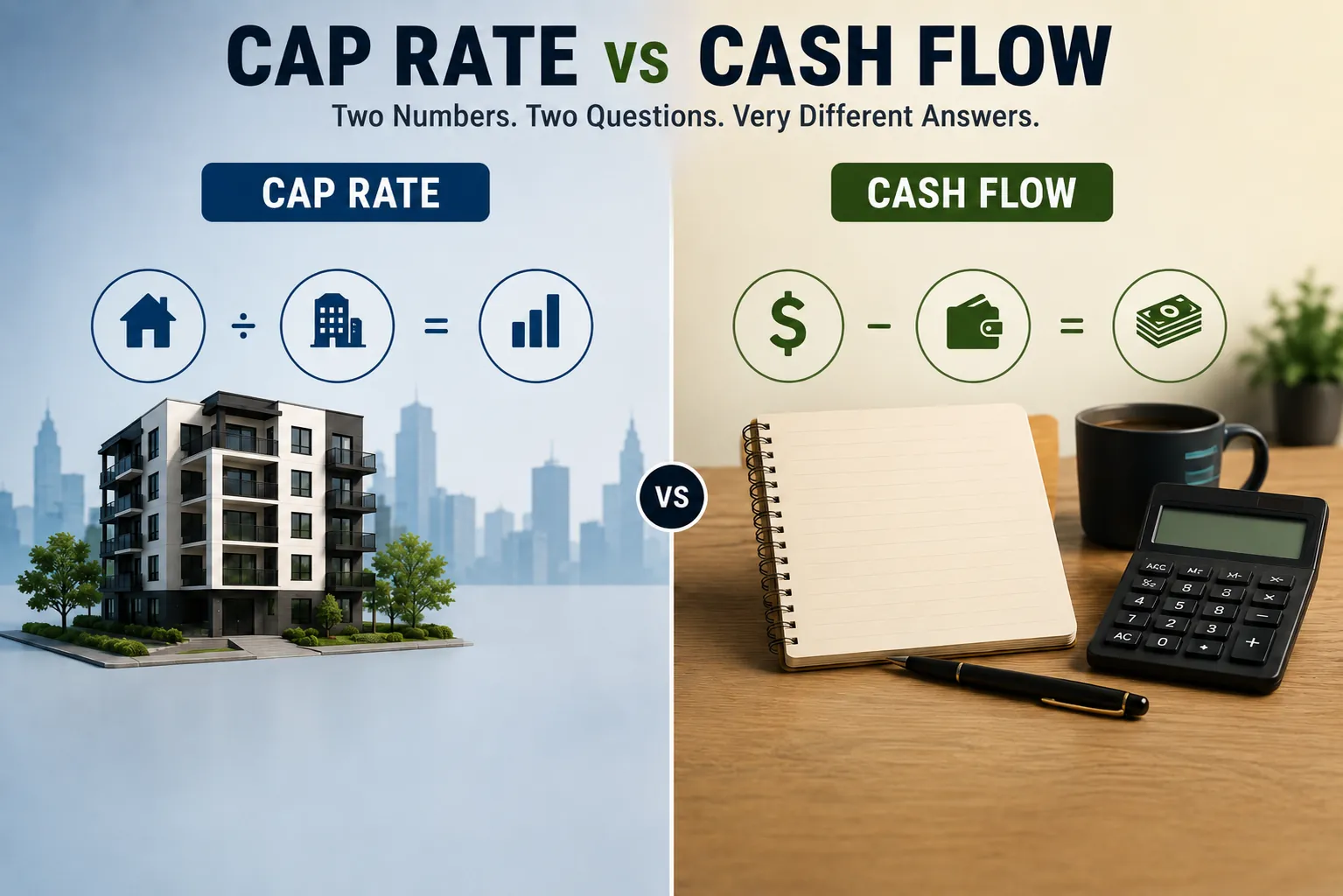
Two rental properties can look almost identical on paper and produce completely different results in your bank account.
One might have a fantastic cap rate but weak monthly cash flow.
Another might have a lower cap rate but leave you with far more money every month.
So when comparing cap rate vs cash flow, which number actually matters?
The short answer:
Cap rate tells you how efficiently the property itself generates income. Cash flow tells you how much money you actually keep.
They measure different things, and understanding that difference can stop you from choosing a property based on the wrong number.
Cap Rate vs Cash Flow: The Quick Difference
Here is the simplest way to think about it.
Cap rate asks:
How profitable is this property before financing?
Cash flow asks:
How much money is actually left after my expenses?
That difference matters because two investors can buy the exact same property and have the exact same cap rate, but completely different cash flow depending on how they finance it.
What Is Cap Rate?
Capitalization rate, usually shortened to cap rate, compares a property's net operating income with its value.
The basic formula is:
Cap Rate = Net Operating Income ÷ Property Value × 100
Suppose a rental property is worth:
$300,000
and produces:
$18,000 in annual net operating income
The cap rate is:
$18,000 ÷ $300,000 × 100 = 6%
So the property has a 6% cap rate.
What counts as net operating income?
Net operating income, or NOI, generally means rental income after normal operating expenses such as:
- Property taxes
- Insurance
- Maintenance
- Property management
- Utilities paid by the landlord
- HOA or service charges
- Other operating costs
Mortgage payments are normally excluded.
That is important.
Cap rate is designed to help you judge the property itself, rather than the financing used to buy it.
→ Try Propertira's Cap Rate Calculator
Enter your property value, rental income and expenses to calculate your rental property's cap rate instantly.
What Is Rental Property Cash Flow?
Rental property cash flow is the money left after income and the expenses you are including in your calculation.
A simple formula is:
Rental Income − Property Expenses = Cash Flow
Unlike cap rate, cash flow commonly includes the mortgage payment when you are trying to understand how much money actually enters or leaves your bank account.
Suppose:
Monthly rent: $2,500
and your monthly costs are:
- Mortgage: $1,300
- Taxes: $250
- Insurance: $100
- Management: $150
- Maintenance reserve: $150
- Other costs: $100
Total expenses:
$2,050
Your monthly cash flow is:
$2,500 − $2,050 = +$450
That $450 is much closer to answering the question most landlords eventually care about:
What does this property actually leave me each month?
→ Try Propertira's Cash Flow Calculator
Enter your rental income and expenses to see how much monthly and annual cash flow your property produces.
The Big Difference: Financing
This is where cap rate vs cash flow gets interesting.
Imagine two investors buy identical properties.
Each property:
- Costs $300,000
- Generates $30,000 in annual rent
- Has $12,000 in annual operating expenses
That gives both properties:
NOI = $18,000
and:
Cap rate = 6%
The cap rate is identical.
But now suppose Investor A has a very expensive mortgage while Investor B has a much smaller mortgage.
Their actual cash flow can be wildly different.
Same property.
Same cap rate.
Different financial outcome.
This is why cap rate does not tell you whether your particular financing arrangement produces good cash flow.
Property A vs Property B
Here is a more useful example.
Property A
Property value: $250,000 Annual NOI: $17,500
Cap rate:
7%
That looks attractive.
But Property A has an expensive mortgage.
After mortgage payments and the other costs you are including, it produces only:
+$100/month cash flow
Property B
Property value: $300,000 Annual NOI: $18,000
Cap rate:
6%
The cap rate is lower.
But Property B has cheaper financing and produces:
+$500/month cash flow
So which property is better?
Property A
Higher cap rate: 7% Cash flow: +$100/month
Property B
Lower cap rate: 6% Cash flow: +$500/month
There is no automatic winner.
It depends on what you are trying to measure.
When Cap Rate Matters More
Cap rate is particularly useful when you want to compare properties without letting different mortgages distort the comparison.
Imagine you are looking at three rental properties.
One is financed with 20% down.
One with 40% down.
One might even be purchased with cash.
Comparing their monthly cash flow alone would partly tell you about their financing structures, not just the quality of the underlying properties.
Cap rate gives you another lens.
It can help answer:
- How much income does this property generate relative to its value?
- Is one property producing more NOI for every dollar of property value?
- How do two similar rental properties compare before financing?
- Is the property's operating performance improving or declining?
It is essentially a property-level efficiency metric.
When Cash Flow Matters More
Cash flow becomes much more important when the question is personal:
Can I actually afford to own this property?
A rental might have an attractive cap rate but still leave you contributing money each month because of:
- Expensive financing
- High mortgage payments
- Unexpected repairs
- Vacancy
- Management costs
- Other ownership expenses
Cash flow helps answer practical questions such as:
- Does this property pay for itself?
- How much money will I keep each month?
- Can the property absorb a repair?
- How much breathing room do I have?
- Is one rental quietly draining my portfolio?
If your goal is monthly income, cash flow deserves a lot of attention.
A High Cap Rate Does Not Automatically Mean High Cash Flow
This is probably the most important mistake to avoid.
Imagine a property with:
Cap rate: 8%
That sounds excellent.
But suppose the mortgage is so expensive that the property produces:
−$150/month cash flow
Now compare it with another property:
Cap rate: 6%
but:
+$450/month cash flow
The first property might still be attractive for other reasons.
But the phrase "8% cap rate" does not magically put money in your bank account.
Cap rate and cash flow simply answer different questions.
And High Cash Flow Does Not Automatically Mean a Great Property
The reverse can also happen.
Suppose you buy a property almost entirely with cash.
Your mortgage payment is tiny or nonexistent.
Naturally, your monthly cash flow may look fantastic.
But that does not necessarily mean the property is generating a strong return relative to its value.
Imagine a $600,000 property produces only $24,000 in annual NOI.
Its cap rate is:
$24,000 ÷ $600,000 = 4%
The cash flow might look healthy because there is little debt.
But another property could potentially generate much more operating income relative to the capital tied up in it.
Again, one metric cannot tell the entire story.
So Which Number Should Landlords Focus On?
For most rental-property owners, the best answer is:
Look at both.
Use cap rate to understand the property's operating performance relative to its value.
Use cash flow to understand what happens to your actual money after financing and other costs.
You can think of them as two different camera angles.
Cap Rate
"How does the property perform?"
Cash Flow
"How does this investment perform for me?"
Those are related questions.
They are not the same question.
Cap Rate vs Cash Flow Example
Imagine two properties:
| Property A | Property B | |
|---|---|---|
| Property Value | $250,000 | $300,000 |
| Annual NOI | $17,500 | $18,000 |
| Cap Rate | 7% | 6% |
| Monthly Cash Flow | $100 | $500 |
If your priority is finding the property with stronger operating income relative to price:
Property A looks stronger.
If your priority is producing monthly income under your current financing:
Property B looks stronger.
That is exactly why asking:
"What is a good cap rate?"
without looking at anything else can be misleading.
The better question is:
"What does this metric tell me, and what does it leave out?"
Do Not Make a Rental Decision From One Number
Rental investments contain too many moving pieces for one percentage to tell you everything.
A property can have:
- Strong cap rate
- Weak cash flow
- High maintenance
- Low vacancy
- Expensive financing
Another can have:
- Lower cap rate
- Strong cash flow
- Cheap financing
- Higher vacancy risk
The purpose of metrics is not to find one magical number.
It is to understand the property from several useful angles.
Fortunately, cap rate and cash flow make a very good starting pair.
One helps you evaluate the property.
The other helps you evaluate what the property does to your wallet.
Calculate Both Before You Decide
If you are evaluating a rental property, calculate both numbers rather than choosing between them.
→ Calculate Your Cap Rate
Use Propertira's Cap Rate Calculator to measure net operating income relative to your property's value.
→ Calculate Your Cash Flow
Use Propertira's Cash Flow Calculator to see how much money your rental actually leaves after expenses.
A property with a great cap rate can still produce disappointing cash flow.
A property with strong cash flow can still have a relatively modest cap rate.
Neither number is useless.
Neither number tells the whole story.
The useful part is knowing what each one is actually measuring.
Work it out on your own numbers
Cap rate calculator runs this maths for you - enter your rent and costs and see the result straight away. No sign-up needed.\n
- cap rate calculator
- cap rate vs cash flow
- rental property cap rate
- rental property cash flow
- rental property investment metrics
Related guides
- Rental Property Payback Period: How to Calculate It (with Examples)The rental property payback period measures how many years it takes for cumulative net cash flow to recover your upfront cash investment. Here is how to calculate it accurately.
- Break-Even Occupancy Rate: How to Calculate It for Rental PropertiesCalculate the exact percentage of the year your rental property must stay occupied to cover all operating expenses and mortgage payments without losing cash.
- Keep or Sell? How to Run the Numbers on an Underperforming RentalDeciding whether to keep or sell an underperforming rental comes down to Return on Equity and opportunity cost. Here is how to run the numbers step by step.
Put this into practice
Use the free calculators with your own figures, or track every property in one place with Propertira.
Propertira provides estimates based on the information you enter. Results are for informational purposes only and are not financial, tax, legal or investment advice.