Rental Property Expenses: Complete Landlord Checklist
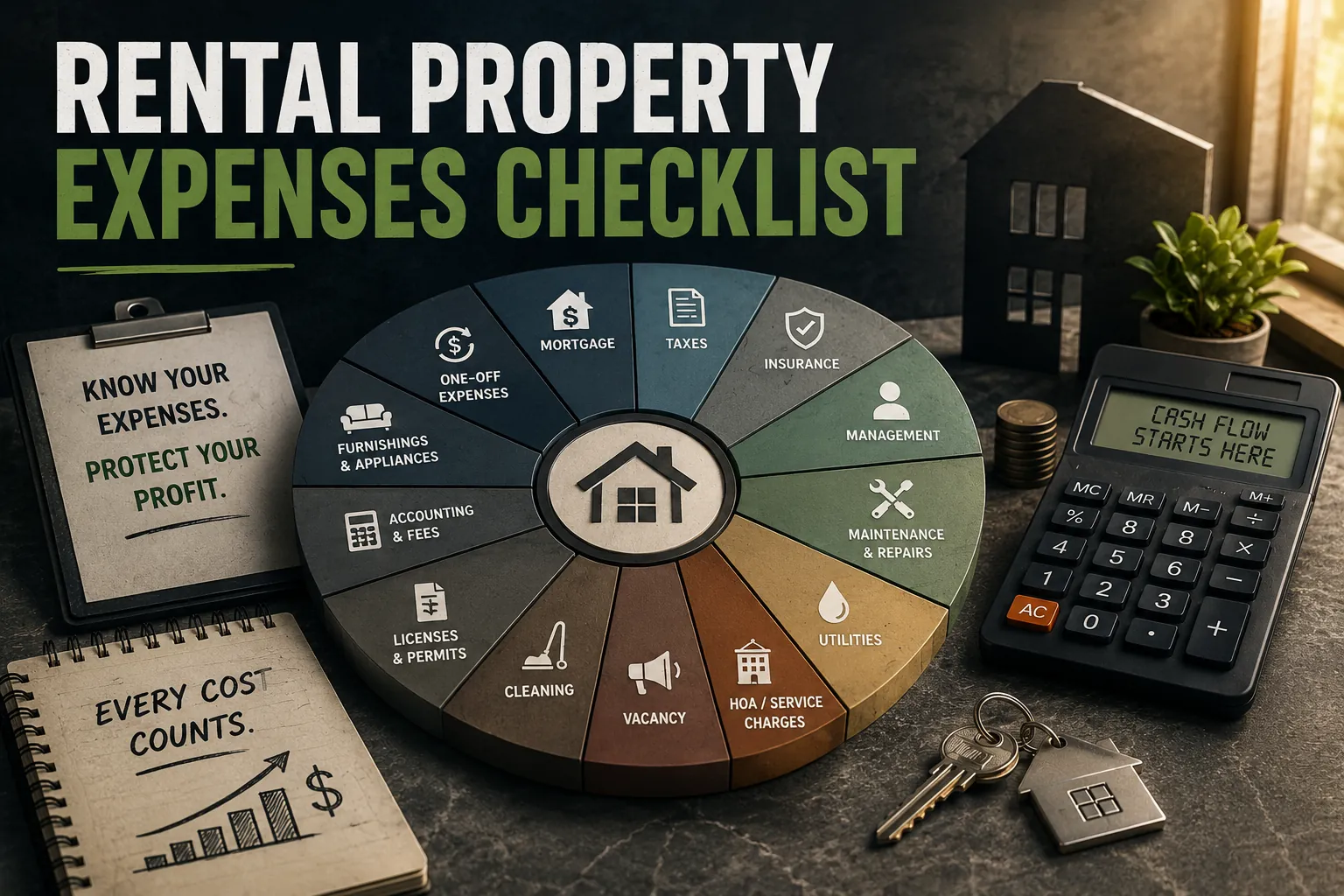
Not sure which rental property expenses to include in your cash flow calculations? This complete landlord expense checklist covers mortgage costs, taxes, insurance, repairs, vacancy, management fees and more.
Rental Property Expenses: Complete Landlord Checklist
URL: /blog/rental-property-expenses-checklist
Rent is easy to see.
Expenses are where rental-property maths gets slippery.
A mortgage payment is obvious. So is a major repair. But property taxes, insurance, vacancy, management fees, utilities, service charges and dozens of smaller costs can quietly eat into what looked like a healthy rental return.
That is why calculating rental profitability starts with one deceptively simple task:
Know what the property actually costs you.
This complete rental property expense checklist covers the major costs landlords should consider when calculating cash flow, comparing properties or deciding whether a rental is genuinely profitable.
Quick Rental Property Expense Checklist
When calculating the cost of owning a rental property, consider:
- Mortgage payments
- Property taxes
- Landlord insurance
- Property management fees
- Maintenance
- Repairs
- Utilities
- HOA or service charges
- Vacancy
- Cleaning
- Advertising and tenant-finding costs
- Licensing and permits
- Accounting and professional fees
- Furnishings and appliances
- One-off expenses
- Replacement reserves
Not every property will have every expense.
But forgetting even a few can make a profitable-looking rental look much better on paper than it performs in reality.
1. Mortgage Payments
For many landlords, the mortgage is the largest recurring property expense.
Suppose your monthly mortgage payment is:
$1,350
and your rent is:
$2,000
It is tempting to think:
$2,000 − $1,350 = $650 profit
Unfortunately, the mortgage is usually just the beginning.
You still need to account for taxes, insurance, maintenance, vacancy and everything else required to keep the property running.
A useful distinction
A mortgage payment may contain both:
- Interest
- Principal repayment
Principal repayment increases your equity, so it is not the same as an operating expense from an accounting perspective.
But if you are measuring monthly cash flow, the full payment still leaves your bank account.
For a landlord asking:
"How much cash does this property actually leave me every month?"
the full mortgage payment is therefore highly relevant.
2. Property Taxes
Property taxes can represent a substantial annual cost and are easy to underestimate because they may not arrive as a monthly bill.
Suppose your property tax is:
$3,000 per year
That is effectively:
$250 per month
Even if you pay it annually, spreading the amount across 12 months gives you a clearer picture of the property's real monthly cost.
This is useful for any expense that arrives quarterly, annually or irregularly.
3. Landlord Insurance
Rental properties normally require appropriate insurance coverage.
The cost will vary depending on the property, location, coverage and insurer.
For cash-flow purposes, convert the annual premium into a monthly figure.
For example:
$1,440 annual insurance ÷ 12 = $120/month
That $120 belongs in your rental-property calculation even if the invoice appears only once per year.
4. Property Management Fees
If someone else manages the property for you, management fees can materially affect profitability.
Depending on your arrangement, you may pay for things such as:
- Ongoing property management
- Rent collection
- Tenant communication
- Inspections
- Maintenance coordination
- Tenant placement
- Lease renewals
Imagine a property generates $2,200 in monthly rent and management costs $180 per month.
That is already:
$2,160 per year
leaving the property before repairs, taxes or insurance enter the picture.
Management can still be valuable, particularly if it saves substantial time or allows you to operate remotely.
The important thing is simply to include it in your numbers.
5. Routine Maintenance
Maintenance is the quiet background cost of owning property.
It includes the small jobs that keep everything working:
- Servicing heating or cooling systems
- Plumbing maintenance
- Gardening
- Minor electrical work
- Painting
- Cleaning common areas
- Preventive maintenance
- Replacing worn fixtures
These costs may look insignificant individually.
Over a year, they can add up surprisingly quickly.
One useful approach is to track maintenance separately from major repairs so you can see whether routine costs are gradually increasing.
6. Repairs
Maintenance keeps things working.
Repairs are what happen when they stop.
A broken appliance, leaking pipe, damaged door or electrical problem can turn a profitable month into a negative one almost instantly.
Consider this example:
Normal monthly cash flow: +$350
Then:
Unexpected repair: $1,200
That month effectively becomes:
$350 − $1,200 = −$850
This does not necessarily mean the property is a bad investment.
It does mean that looking at one normal month can create a misleading picture.
Rental profitability is better understood across longer periods.
7. Utilities
Depending on the rental arrangement, tenants may pay most utilities.
But landlords sometimes remain responsible for certain services, including:
- Water
- Electricity
- Gas
- Heating
- Internet
- Waste collection
- Common-area utilities
Even relatively small utility costs matter when multiplied across a year or across several properties.
If you pay $75 per month in landlord-covered utilities:
$75 × 12 = $900 per year
That should be included in your rental property expenses.
8. HOA Fees and Service Charges
Apartments, condominiums and properties in managed developments may come with:
- HOA fees
- Building service charges
- Maintenance contributions
- Common-area fees
- Reserve fund contributions
These can sometimes be substantial.
And unlike an occasional repair, they are usually recurring.
A property with attractive rent but a heavy service charge may produce much less cash flow than a similar property without one.
Always compare the property's income with the whole cost structure, not just the mortgage.
9. Vacancy
Vacancy is different from most landlord expenses because you are not necessarily paying a bill.
Instead, you are not receiving income.
And financially, that can hurt just as much.
Imagine a property rents for:
$1,800/month
One vacant month means:
$1,800 of rental income disappears
But many of the property's expenses continue:
Mortgage.
Insurance.
Taxes.
Service charges.
Utilities.
Maintenance.
That is why vacancy belongs in any realistic rental-property profitability calculation.
Example
A property generating $1,800 each month could theoretically produce:
$21,600 per year
But with one vacant month:
$1,800 × 11 = $19,800
Your effective annual rental income has fallen by $1,800 before any additional tenant-turnover expenses are included.
10. Cleaning and Turnover Costs
Tenants moving out can create expenses that do not appear during normal months.
You may need to pay for:
- Professional cleaning
- Painting
- Minor repairs
- Carpet cleaning
- Waste removal
- Gardening
- Lock changes
- Property preparation
These expenses are easy to overlook because they may happen only once every few years.
But occasional does not mean irrelevant.
If tenant turnover costs you $1,000 every two years, that is effectively an average cost of:
$500 per year
or around:
$42 per month
Looking at expenses this way can make your cash-flow calculations much more realistic.
11. Advertising and Tenant-Finding Costs
Finding a new tenant may also cost money.
Potential expenses include:
- Rental listing fees
- Photography
- Letting-agent commissions
- Tenant screening
- Referencing
- Showing costs
- Leasing or placement fees
Some landlords rarely incur these costs.
Others pay them almost every time the property changes tenants.
Either way, they should not disappear from your profitability calculation simply because they are irregular.
12. Licensing, Registration and Permit Costs
Depending on where your property is located, you may have landlord-specific regulatory costs.
These could include:
- Rental licences
- Registration fees
- Inspection fees
- Local permits
- Compliance certificates
These rules vary significantly between jurisdictions, so check the requirements applicable to your property.
For financial tracking purposes, include any recurring compliance costs as part of the property's annual expenses.
13. Accounting and Professional Fees
Rental properties can also generate administrative costs.
You may pay for:
- Accounting
- Tax preparation
- Bookkeeping
- Legal services
- Lease preparation
- Financial advice
If these services relate to your rental activity, they still affect the amount of money the investment ultimately leaves you with.
Do not confuse "not paid every month" with "not a property cost."
14. Furnishings and Appliances
Furnished rentals can generate another category of expenses entirely.
Beds wear out.
Sofas get damaged.
Washing machines eventually stop washing.
Refrigerators occasionally decide retirement sounds attractive.
Depending on your property, you may need to replace:
- Furniture
- White goods
- Kitchen equipment
- Lighting
- Curtains or blinds
- Mattresses
- Electronics
A $900 appliance replacement may not happen every year.
But over a long enough ownership period, replacements are inevitable.
15. One-Off Expenses
Some property costs simply refuse to fit neatly into a recurring category.
Examples might include:
- Emergency plumbing
- Major electrical work
- Legal costs
- Pest treatment
- Locksmiths
- Storm damage
- Deep cleaning
- Tenant damage not fully recovered
- Emergency call-outs
This is why looking only at your standard monthly bills can underestimate the true cost of owning a rental.
Your property does not know what a spreadsheet column called "recurring expenses" means.
If money leaves your account because of the rental, it affects your return.
16. Replacement Reserves
A replacement reserve is not necessarily a bill you are paying today.
It is money you mentally or physically set aside for tomorrow.
Major property components eventually need replacing:
- Roof
- Boiler or HVAC system
- Appliances
- Flooring
- Windows
- Furniture
- Plumbing equipment
Suppose you expect long-term replacements to average approximately $2,400 per year.
That is equivalent to:
$200 per month
Building that into your property analysis can give you a more conservative picture of profitability.
Without it, today's cash flow may look excellent right up until the property sends you a four-figure invoice.
Recurring Expenses vs One-Off Expenses
It helps to divide your landlord expenses into two broad categories.
Recurring expenses
These happen regularly:
- Mortgage
- Insurance
- Property taxes
- Management
- HOA or service charges
- Utilities
- Routine maintenance
Variable and one-off expenses
These occur less predictably:
- Repairs
- Appliance replacements
- Cleaning
- Tenant turnover
- Emergency work
- Legal expenses
- Major maintenance
Both matter.
A property can look profitable when you analyse recurring expenses alone but perform very differently once irregular costs are included.
Rental Income and Expenses: A Simple Example
Imagine your property produces:
Rental income
Rent: $2,500/month
Now calculate the monthly costs:
| Expense | Monthly Amount |
|---|---|
| Mortgage | $1,250 |
| Property tax | $220 |
| Insurance | $90 |
| Management | $180 |
| Maintenance | $100 |
| Repairs reserve | $125 |
| HOA/service charge | $110 |
| Vacancy allowance | $125 |
| Total Expenses | $2,200 |
Your estimated cash flow becomes:
$2,500 − $2,200 = +$300/month
At first glance, you might have compared only rent and mortgage:
$2,500 − $1,250 = $1,250
That would make the property appear to generate more than four times as much monthly cash.
Same property.
Same rent.
Much better expense tracking.
The Expense Most Landlords Forget
There is no single expense that every landlord forgets.
The real problem is usually irregularity.
Monthly expenses are easy to remember because they keep appearing.
Annual and unexpected expenses disappear from sight between payments.
That can create a distorted view of performance.
A useful rule is:
Convert every meaningful annual cost into a monthly average.
If insurance costs $1,200 annually:
$1,200 ÷ 12 = $100/month
If repairs averaged $2,400 over the last year:
$2,400 ÷ 12 = $200/month
If turnover costs roughly $1,200 every three years:
$1,200 ÷ 36 = about $33/month
Now you can compare everything against monthly rental income using the same timeframe.
Gross Rent Is Not Profit
This sounds obvious.
But it is one of the easiest mistakes to make when evaluating rental property.
A property generating:
$30,000 per year in rent
is not necessarily a better investment than one generating:
$24,000
because the first property might cost:
$27,000 per year to operate
while the second costs:
$17,000
Their approximate cash flow would be:
Property A
$30,000 − $27,000 = $3,000
Property B
$24,000 − $17,000 = $7,000
Property B collects less rent.
But it leaves considerably more money behind.
That is why rental income should rarely be viewed without rental expenses beside it.
Track Expenses Property by Property
If you own several rentals, combining every expense into one giant portfolio number can hide problems.
Imagine:
Property A: +$650/month
Property B: +$420/month
Property C: −$310/month
Your overall portfolio still produces:
+$760/month
That sounds healthy.
But Property C is being subsidised by the other two.
Tracking income and expenses separately for each rental makes underperformance much easier to spot.
It also helps answer questions such as:
- Which property generates the strongest cash flow?
- Which property costs the most to maintain?
- Where are repairs increasing?
- Which property has the highest expense-to-rent ratio?
- Is one rental dragging down the portfolio?
Once your portfolio grows, these differences become increasingly important.
How Often Should You Review Rental Property Expenses?
You do not need to obsess over the numbers every morning.
But your expense assumptions should not remain frozen for years either.
Review them whenever something significant changes, such as:
- Rent increases or decreases
- Mortgage changes
- Insurance renewal
- Property-tax changes
- New management fees
- Major repairs
- Tenant turnover
- Service-charge increases
- Long vacancy periods
A periodic review also helps catch gradual expense creep.
An extra $25 here and $40 there rarely feels dramatic.
Across several expense categories and several properties, it can become hundreds of dollars per month.
Rental Property Expense Checklist
Use this when reviewing one of your rentals:
Financing
- Mortgage payment
- Other property-related financing costs
Ownership
- Property tax
- Insurance
- HOA or service charges
- Licensing and registration
Operations
- Property management
- Utilities
- Routine maintenance
- Cleaning
- Gardening
Irregular Costs
- Repairs
- Emergency maintenance
- Appliance replacements
- Tenant turnover
- Legal or professional costs
Lost Income
- Vacancy
- Unpaid rent where relevant
Long-Term Planning
- Replacement reserve
- Major maintenance reserve
If you cannot confidently fill in most of these numbers, your current cash-flow estimate may be incomplete.
Knowing Your Expenses Is Step One
You can have strong rental income and still own an underperforming property.
The missing piece is usually everything happening underneath that rent figure.
Mortgage.
Taxes.
Repairs.
Vacancy.
Insurance.
Management.
Maintenance.
Small costs that quietly become large ones.
That is why the first step is knowing your expenses.
The second is seeing what they actually do to your cash flow.
Knowing your expenses is step one. Seeing what they do to your cash flow every month is step two.
→ See your rental cash flow with Propertira
Track rental income and expenses property by property, see what each rental actually leaves you every month, and understand where your money is going without building another spreadsheet.
Because the number that matters is not how much rent your property collects.
It is how much of that rent you keep.
Tax and accounting treatment of rental-property expenses varies by country and individual circumstances. This article focuses on property cash-flow tracking rather than tax-deductibility rules.
Work it out on your own numbers
Rental property profit calculator runs this maths for you - enter your rent and costs and see the result straight away. No sign-up needed.\n
- landlord expenses
- rental income and expenses
- rental property cash flow
- rental property expense checklist
- rental property expenses
Related guides
- Rental Property Sinking Fund: How to Budget for Major ReplacementsA rental property sinking fund prevents major capital expenses from wiping out your monthly cash flow. Here is how to calculate monthly contributions based on asset lifespans.
- HOA Fees on Rental Property: How Dues and Special Assessments Impact Cash FlowHOA fees directly reduce monthly rental profit, while sudden special assessments can wipe out an entire year of cash flow. Learn how to budget and evaluate association properties accurately.
- Should Landlords Pay Utilities? The Real Impact on Rental Cash FlowDeciding whether to include utilities in the rent directly affects your operating risk and net profit margin. Here is how to evaluate the cash-flow impact.
Put this into practice
Use the free calculators with your own figures, or track every property in one place with Propertira.
Propertira provides estimates based on the information you enter. Results are for informational purposes only and are not financial, tax, legal or investment advice.