Rental Property Profit Margin: How Much of Your Rent Do You Actually Keep?
How much of your rent is actually profit? Learn how to calculate rental property profit margin, account for expenses, and see how much rental income you really keep.
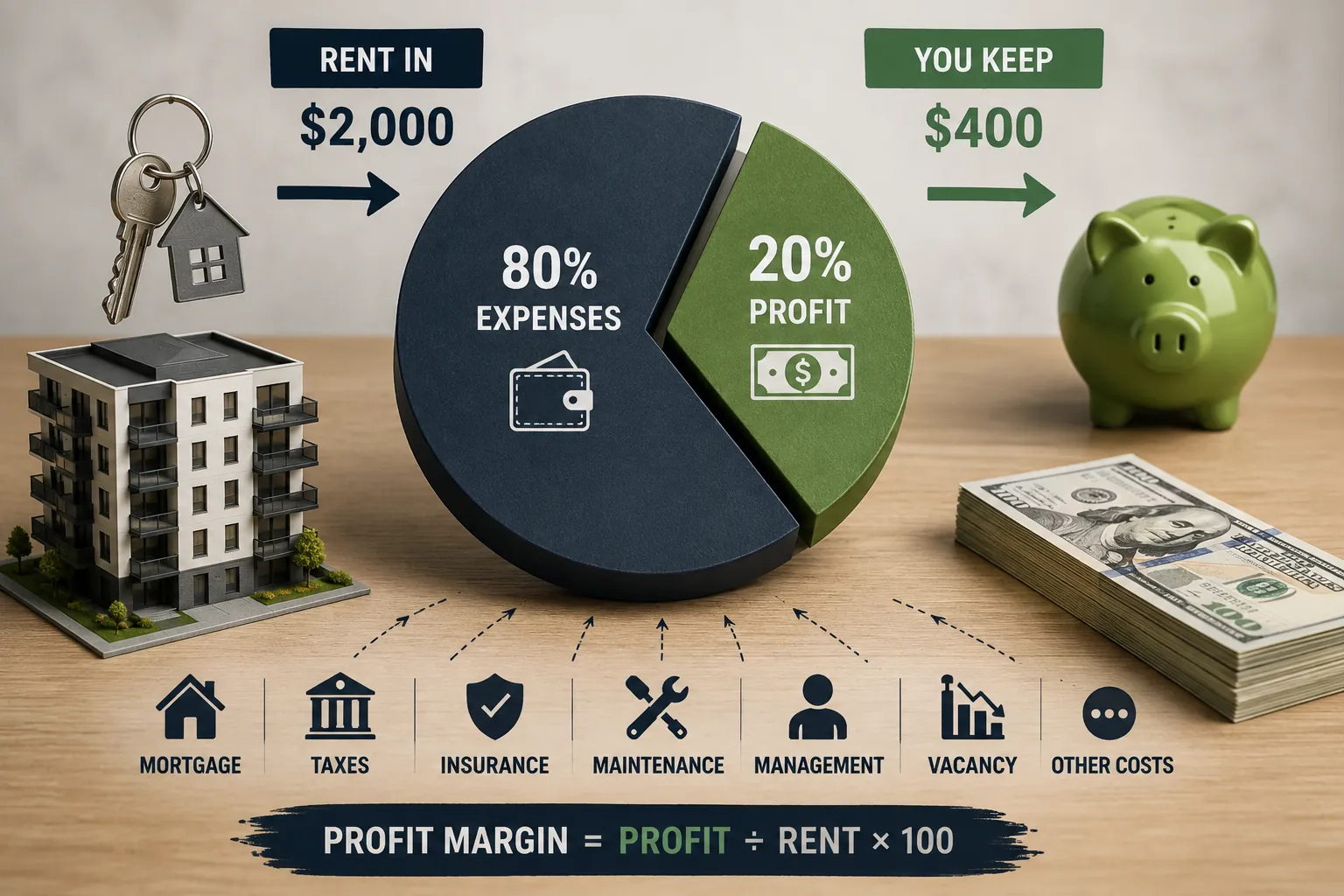
A rental property brings in $2,000 a month.
Sounds healthy.
But after the mortgage, insurance, maintenance, management, vacancy and everything else, perhaps only $350 is actually left.
That changes the picture.
Because the important question is not simply:
“How much rent does this property collect?”
It is:
“How much of that rent do I actually keep?”
That is where your rental property profit margin becomes useful.
It turns rental income into a simple percentage that shows how much of every dollar of rent survives after expenses.
What Is Rental Property Profit Margin?
A rental property profit margin compares the money left after expenses with the rental income the property generates.
A simple practical formula is:
Profit Margin = Rental Profit ÷ Rental Income × 100
For example:
Monthly rent: $2,000 Monthly expenses: $1,600 Money remaining: $400
Your rental profit margin is:
$400 ÷ $2,000 × 100 = 20%
In other words:
For every $1,000 of rent collected, approximately $200 is left.
That is often much more revealing than looking at rent alone.
How to Calculate Rental Profit Margin
The calculation takes three steps.
Step 1: Add your rental income
Suppose the property generates:
$2,500/month
Step 2: Subtract the expenses you want included
For example:
- Mortgage: $1,200
- Property tax: $200
- Insurance: $100
- Management: $150
- Maintenance: $150
- Vacancy allowance: $100
- Other expenses: $100
Total:
$2,000/month
Step 3: Calculate the margin
Rental profit:
$2,500 − $2,000 = $500
Profit margin:
$500 ÷ $2,500 × 100 = 20%
So the property keeps roughly:
20 cents of every rental dollar collected.
Why Looking at Rent Alone Can Be Misleading
Suppose two properties each generate:
$2,000/month in rent
At first glance, they look equally productive.
But their expenses tell a different story.
Property A
Rent: $2,000
Expenses: $1,300
Money remaining: $700
Profit margin:
35%
Property B
Rent: $2,000
Expenses: $1,800
Money remaining: $200
Profit margin:
10%
Same rent.
Very different business.
This is why gross rental income can create a flattering picture of a property that is actually expensive to operate.
The “For Every $1,000” Test
One of the easiest ways to understand your landlord profit margin is to convert it into money kept per $1,000 of rent.
If your margin is:
5% → you keep about $50 per $1,000
10% → about $100
20% → about $200
30% → about $300
40% → about $400
This makes the percentage feel much more real.
Imagine collecting $30,000 per year in rent.
At a 10% margin:
$3,000 remains
At a 30% margin:
$9,000 remains
A twenty-percentage-point difference suddenly becomes $6,000 a year.
Percentages get much more interesting when they turn back into money.
Which Expenses Should You Include?
This depends on exactly what you are trying to measure.
For a practical cash-flow view of your rental, you may want to include costs such as:
- Mortgage payments
- Property taxes
- Insurance
- Management fees
- Maintenance
- Repairs
- Utilities paid by the landlord
- HOA or service charges
- Vacancy allowance
- Cleaning
- Licensing
- Accounting
- Other property-related costs
The important thing is consistency.
If you calculate one property's margin including vacancy and maintenance but ignore those costs on another property, your comparison will be distorted.
Do You Include the Mortgage?
This is where definitions matter.
If you are calculating formal accounting profit, mortgage principal is not treated in the same way as an ordinary operating expense because paying down principal increases your equity.
But many landlords are asking a more practical question:
“After everything leaves my bank account this month, how much rent is actually left?”
For that kind of cash-flow analysis, including the full mortgage payment can be useful.
Just be clear about what your number represents.
At Propertira, the practical question is often the most useful one:
What comes in, what goes out, and what is left?
Vacancy Can Shrink Your Margin Fast
Suppose your property normally generates:
$2,000/month
or:
$24,000/year
Your annual expenses total:
$18,000
With full occupancy:
$24,000 − $18,000 = $6,000
Profit margin:
25%
But now the property sits empty for one month.
Annual rent falls to:
$22,000
If most expenses remain the same:
$22,000 − $18,000 = $4,000
Your margin becomes:
18.2%
One vacant month took the property from:
25% → 18.2%
That is a substantial drop without the rent changing at all.
This is why vacancy should not live in a separate mental drawer from profitability.
It directly affects what you keep.
Repairs Can Hide Behind a Good Month
A rental can look fantastic during a quiet month.
Rent:
$2,000
Normal expenses:
$1,500
Profit:
$500
Margin:
25%
Then the washing machine dies.
Or the boiler needs work.
Or a tenant moves out and the property needs painting.
Suddenly a $1,500 repair arrives.
Looking only at one month would make the property appear unprofitable.
Looking only at the previous month would make it appear wonderfully healthy.
Neither tells the full story.
For irregular expenses, it can be more useful to calculate averages over several months or an entire year.
If you spend approximately $2,400 per year on repairs, treating that as an average:
$2,400 ÷ 12 = $200/month
can give you a more realistic ongoing picture.
Profit Margin vs Cash Flow
These two metrics are closely related, but they answer slightly different questions.
Cash flow tells you:
How much money is left?
For example:
+$500/month
Profit margin tells you:
How much of my rental income is left?
For example:
20%
Cash flow gives you a dollar amount.
Profit margin gives you context.
A property producing $500 per month from $2,000 of rent has a very different cost structure from one producing $500 from $5,000 of rent.
The first keeps:
25%
The second keeps:
10%
Same cash flow.
Very different efficiency.
Profit Margin vs Cap Rate
These metrics should not be confused either.
Cap rate generally compares a property's net operating income with its value while excluding financing.
Rental profit margin compares the amount left with the rental income generated.
For example, cap rate might tell you:
“This property produces a 6% operating return relative to its value.”
Profit margin might tell you:
“After the expenses I am tracking, I keep 22% of the rent.”
They are different camera angles on the same property.
One does not replace the other.
What Is a Good Rental Property Profit Margin?
There is no universal percentage that automatically makes a rental good or bad.
A reasonable margin can depend on:
- Financing
- Property type
- Location
- Maintenance requirements
- Vacancy
- Your investment strategy
- How you define expenses
- How much capital you invested
A 15% margin may be perfectly acceptable for one property and disappointing for another.
What matters more is understanding the direction.
If your margin moves:
25% → 21% → 17% → 12%
while rent stays roughly unchanged, something is eating into the property's performance.
That deserves investigation.
Why Profit Margin Is Especially Useful Across Several Properties
Imagine you own three rentals.
Property A
Rent: $2,000 Cash flow: $500 Margin: 25%
Property B
Rent: $3,000 Cash flow: $450 Margin: 15%
Property C
Rent: $1,600 Cash flow: $480 Margin: 30%
Property B collects the most rent.
But Property C keeps the highest share of what it collects.
Looking at rental income alone would never show you that.
This becomes especially useful as a portfolio grows.
Rather than asking:
“Which property has the highest rent?”
you can ask:
“Which property uses its rent most efficiently?”
Watch Your Margin Over Time
Your rental profit margin is not fixed.
Expenses creep.
Insurance renews higher.
Service charges increase.
Repairs become more frequent.
Vacancy lasts longer.
A property producing a 28% margin today might quietly fall to 18% over the next few years.
That is why tracking the trend can be more useful than calculating the number once and forgetting it.
If the margin drops, you can investigate what changed.
Maybe rent has not kept pace with expenses.
Maybe maintenance is climbing.
Maybe financing changed.
Maybe one-off costs are becoming suspiciously regular.
The number tells you where to start looking.
From Rent Collected to Money Kept
Rental income tells you how much money enters the property.
Profit margin tells you how much survives.
That difference matters.
A rental collecting $3,000 per month might look more impressive than one collecting $2,000.
But if the first keeps $300 and the second keeps $600, the smaller rental is doing considerably more with every dollar it receives.
So instead of stopping at:
“My property earns $2,500 a month.”
Ask:
“How much of that $2,500 actually stays with me?”
That is the number worth watching.
→ See Where Your Rental Income Actually Goes
Use Propertira to track rent, expenses and cash flow property by property and see exactly where your money is going.
Your Where Your Money Goes dashboard turns rental income into a clear breakdown of costs and what remains.
Because collecting rent is only half the story.
What matters is how much you keep.
This article uses profit margin as a practical rental cash-flow measure. Accounting and tax definitions of profit may differ depending on jurisdiction and individual circumstances.
How Much Profit Should a Rental Property Make Per Month?
There is no universal number, so work backwards from your own costs instead of chasing an average. In practice most small landlords aim for a monthly cash flow that is clearly positive after every real cost is counted - mortgage, management, insurance, tax, maintenance and a vacancy allowance - and a profit margin they are comfortable defending in a bad month.
Five steps get you the monthly figure:
- Add all income for the property: rent plus any pet, parking or storage payments.
- Subtract the fixed monthly costs: mortgage payment, insurance, property tax, service charges.
- Subtract the variable costs: management fees, landlord-paid utilities, letting and renewal fees.
- Subtract reserves: a maintenance allowance and a vacancy allowance, so one bad month does not wipe out the year.
- What remains is your monthly cash flow. Divide it by income and multiply by 100 for the margin.
Example: rent 2,300, fixed costs 1,450, variable costs 230, reserves 170. Monthly cash flow is 450, and the margin is 450 / 2,300 x 100 = 19.6%. Those figures are an illustration, not an average.
Why the monthly number and the margin disagree
A property can clear a healthy 500 a month on a large, expensive unit and still run a thin margin, while a small unit with 200 of cash flow can hold a much better one. The monthly number tells you what lands in your account; the margin tells you how much of each rent payment you actually keep, and how much room you have before a rate rise or an empty month turns it negative.
How much profit should a rental property make per month?
Enough to cover every recurring cost, fund maintenance and vacancy reserves, and leave a surplus you would still accept if rent stalled for a year. Run the cash flow calculator with your own numbers rather than adopting someone else's target.
Is average rental profit a useful benchmark?
Not really. Published averages mix cities, property types and financing, so they rarely describe your property. Your own break-even rent and margin are far more useful - work out your break-even rent and compare it with the rent you actually charge.
What if the monthly profit is negative?
Treat it as a cost problem, not a rent problem, until you have checked the expense side line by line. Propertira shows the monthly figure per property so you can see which cost is doing the damage.
- landlord profit margin
- rental income profit
- rental profit margin
- rental property cash flow
- rental property profit margin
Related guides
- Rental Property Profit and Loss (P&L) Statement: A Practical Landlord GuideA rental property profit and loss (P&L) statement tracks your real revenue against actual operating costs. Here is how small landlords can build, read, and analyze one.
- Rental Property Payback Period: How to Calculate It (with Examples)The rental property payback period measures how many years it takes for cumulative net cash flow to recover your upfront cash investment. Here is how to calculate it accurately.
- Break-Even Occupancy Rate: How to Calculate It for Rental PropertiesCalculate the exact percentage of the year your rental property must stay occupied to cover all operating expenses and mortgage payments without losing cash.
Put this into practice
Use the free calculators with your own figures, or track every property in one place with Propertira.
Propertira provides estimates based on the information you enter. Results are for informational purposes only and are not financial, tax, legal or investment advice.