Ratio Utility Billing System (RUBS): How Landlords Recover Utility Expenses
A Ratio Utility Billing System (RUBS) lets small multifamily landlords allocate master-metered water, gas, and trash bills across tenants without costly submetering.
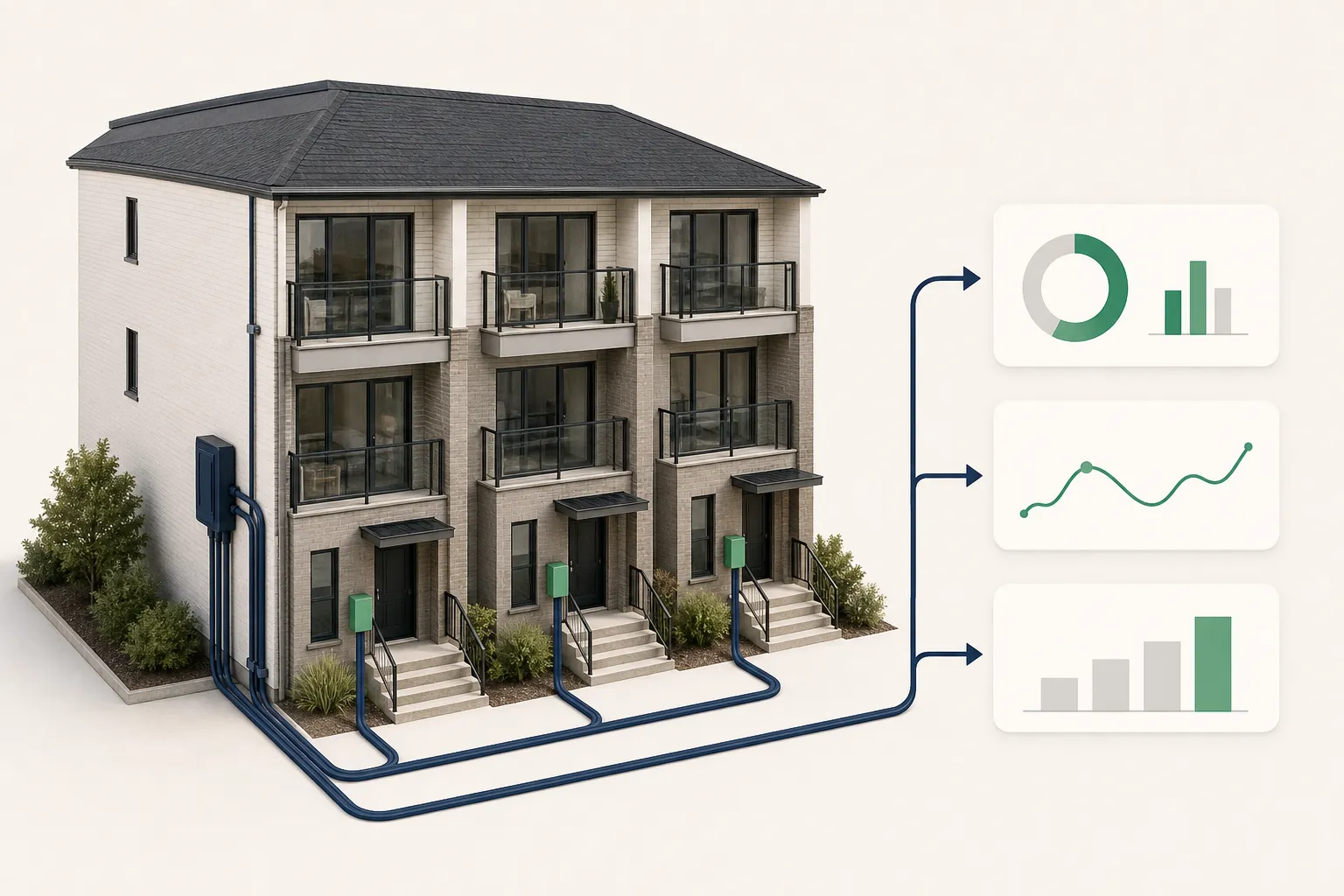
Ratio Utility Billing System (RUBS): How Landlords Recover Utility Expenses
Why Master-Metered Utilities Erode Small Multifamily Margins
When a multifamily property shares a single water, gas, or trash meter, paying those utility bills directly out of gross rent directly reduces your monthly net income. A Ratio Utility Billing System (RUBS) solves this problem by allocating shared utility bills among tenants using predetermined formulas based on square footage, occupant count, or fixture counts.
Installing physical submeters across a triplex or fourplex often costs thousands of dollars in plumbing and electrical retrofits. In many older buildings, retrofitting separate lines is physically impossible without tearing through walls.
Absorbing rising municipal water rates and fluctuating winter heating bills turns a predictable operating budget into a volatile expense line. Evaluating whether you should pay utilities or pass them through is often the single fastest lever to stabilize cash flow on small multifamily properties.
Implementing RUBS creates a systematic way to bill back shared utility costs each month, protecting your profit margins while encouraging tenants to be mindful of their resource consumption.
How RUBS Works in Practice
RUBS does not measure exact individual unit usage. Instead, it takes the property's master bill, deducts common-area usage (such as shared laundry rooms or hallway lighting), and splits the remaining balance across occupied units according to a transparent mathematical formula.
Here is how the workflow functions each billing cycle:
- Receive the master utility bill from the municipal provider (e.g., $600 for water and sewer).
- Deduct the common-area deduction (CAD): Subtract a set percentage (typically 5% to 15%) for landlord-controlled spaces.
- Apply the allocation formula: Distribute the net bill across occupied units using square footage, occupant count, or a blended ratio.
- Issue utility invoices or ledger charges: Bill tenants alongside their standard rent due date.
- Collect reimbursement: Apply recovered funds directly against operating expenses.
`` Net bill to allocate = Total master bill - Common area deduction Unit share = Net bill to allocate x Unit allocation percentage ``
Unlike an arbitrary flat fee, RUBS fluctuates alongside actual utility bills. If city rates jump 12% or winter gas usage doubles, the reimbursement scales automatically, preventing unexpected expense spikes from destroying your rental property profit margin.
The Three Core RUBS Allocation Methods
Choosing the right allocation formula depends on the specific utility being billed. Different utilities correlate differently with property layout versus human behavior.
``` +----------------------+---------------------------+-----------------------------------+
| Allocation Method | Best Suited Utilities | Primary Metric | +----------------------+---------------------------+-----------------------------------+
| Occupant Count | Water, Sewer, Trash | Total approved residents per unit |
| Square Footage | Gas Heating, Central HVAC | Unit rentable square feet |
| Blended Ratio | Multi-Utility Master Bills| 50% Occupants + 50% Area | +----------------------+---------------------------+-----------------------------------+ ```
1. Occupant-Based Allocation (Best for Water and Trash)
Water consumption and trash production correlate directly with the number of people living in an apartment rather than unit size. A single tenant in a large two-bedroom apartment typically uses far less water than a family of four in a compact two-bedroom apartment.
`` Unit share = Unit occupants / Total property occupants x Net bill to allocate ``
2. Square-Footage Allocation (Best for Heating and Gas)
Heating and cooling costs scale primarily with the volume of space being conditioned. A 1,200 sq. ft. unit requires significantly more British Thermal Units (BTUs) of gas to heat than a 600 sq. ft. unit, regardless of occupant count.
`` Unit share = Unit square footage / Total occupied square footage x Net bill to allocate ``
3. Blended Allocation (50/50 Formula)
A blended model splits the bill into two equal halves: 50% is allocated by square footage and 50% by occupant count. This approach balances property footprint with human consumption, making it popular for buildings with single master meters covering combined gas and water.
Worked Example: Allocating Utilities in a 4-Unit Property
To see how the arithmetic works, consider an example 4-unit property with a master water and sewer bill of $500 for the month.
- Master utility bill: $500
- Common Area Deduction (CAD): 10% ($50) absorbed by the landlord for lawn irrigation and exterior hose bibs
- Net bill to allocate: $450
The building details are structured as follows:
- Unit 1: 800 sq. ft., 1 occupant
- Unit 2: 800 sq. ft., 2 occupants
- Unit 3: 1,000 sq. ft., 3 occupants
- Unit 4: 1,000 sq. ft., 2 occupants
- Total property: 3,600 sq. ft., 8 total occupants
Calculating by Occupant Count
Using occupant count for this $450 net water bill:
- Per-occupant cost: $450 / 8 occupants = $56.25 per person
- Unit 1 (1 occupant): $56.25
- Unit 2 (2 occupants): $112.50
- Unit 3 (3 occupants): $168.75
- Unit 4 (2 occupants): $112.50
Calculating by Square Footage
If the same $450 bill represented central building gas heat allocated by area:
- Unit 1 (800 / 3,600 = 22.22%): $450 x 0.2222 = $100.00
- Unit 2 (800 / 3,600 = 22.22%): $450 x 0.2222 = $100.00
- Unit 3 (1,000 / 3,600 = 27.78%): $450 x 0.2778 = $125.00
- Unit 4 (1,000 / 3,600 = 27.78%): $450 x 0.2778 = $125.00
In both methods, the entire $450 net expense is recovered from tenants. The landlord pays only the $50 common area portion, turning what was once a large operating expense into a near-zero out-of-pocket cost.
The Financial Impact on Cash Flow and Valuation
Recovering $450 per month across a 4-unit building saves $5,400 per year in unrecovered operating expenses. For small landlords, this direct savings alters financial performance in two major ways.
`` Annual savings = $450 per month x 12 months = $5,400 ``
First, keeping that $5,400 directly boosts your net operating cash flow, improving your cash-on-cash return.
Second, every dollar trimmed from operating expenses directly increases Net Operating Income (NOI). In commercial and small multifamily valuations, property value is tied directly to NOI divided by the local capitalization rate.
If comparable properties in your market trade at a 6% capitalization rate, increasing annual NOI by $5,400 increases the asset value significantly:
`` Value increase = Annual expense reduction / Capitalization rate Value increase = $5,400 / 0.06 = $90,000 ``
You can model how recovering utility costs shifts your bottom line using our Rental Property Profit Calculator.
Legal Compliance, Lease Clauses, and Best Practices
Before implementing RUBS, landlords must ensure full compliance with municipal, county, and state laws. Regulations governing utility allocation vary widely by jurisdiction.
Key compliance and operational considerations include:
- Jurisdiction restrictions: Some cities cap the administrative fees landlords can charge or mandate specific calculation formulas. Certain rent-controlled areas prohibit shifting utility burdens onto existing leases.
- Clear lease language: Never implement RUBS mid-lease without explicit written agreement. Introduce RUBS during new tenant placements or at lease renewal. Your utility addendum should clearly outline the exact formula used, billing schedule, common area deduction percentage, and due dates.
- Billing transparency: Keep master utility bills organized and available for tenant inspection. Providing transparency prevents billing disputes and maintains tenant trust.
- Handling vacancies: The landlord must absorb the allocated utility share for vacant units. You cannot shift the vacant unit's percentage onto remaining tenants.
Keeping detailed records of utility billings and fee recoveries is essential when compiling your rental property profit and loss statement.
Tracking Utility Reimbursements with Propertira
RUBS is one of the most practical tools small landlords have to protect net cash flow without capital-intensive construction projects. However, effectively managing billbacks requires disciplined income and expense tracking.
Propertira helps you track property-by-property operating costs, monitor utility expense trends over time, and see exactly how cost recoveries affect your true monthly bottom line.
- rubs
- utility billing
- rental expenses
- multifamily cash flow
- operating costs
Related guides
- Home Warranty for Rental Property: Is It Worth the Cost for Landlords?A home warranty promises predictable repair costs, but fixed premiums, service fees, and claim exclusions often erode rental cash flow faster than a dedicated reserve fund.
- Property Tax Increases: How Landlords Can Protect Rental Cash FlowProperty tax reassessments directly reduce net operating income if left unmanaged. Here is how to model tax hikes, handle escrow shortages, and protect your rental cash flow.
- Tenant Placement Fee: How Leasing Fees Impact Rental Cash FlowA tenant placement fee can consume an entire month of rental income upfront. Here is how leasing fees affect first-year cash flow, yield calculations, and multi-year forecasting.
Put this into practice
Use the free calculators with your own figures, or track every property in one place with Propertira.
Propertira provides estimates based on the information you enter. Results are for informational purposes only and are not financial, tax, legal or investment advice.