The 1% Rule for Rental Property: Does It Actually Work?
Does a rental property need to meet the 1% rule to be a good investment? Learn how the one percent rule works, calculate it quickly, and see why real cash flow matters more.
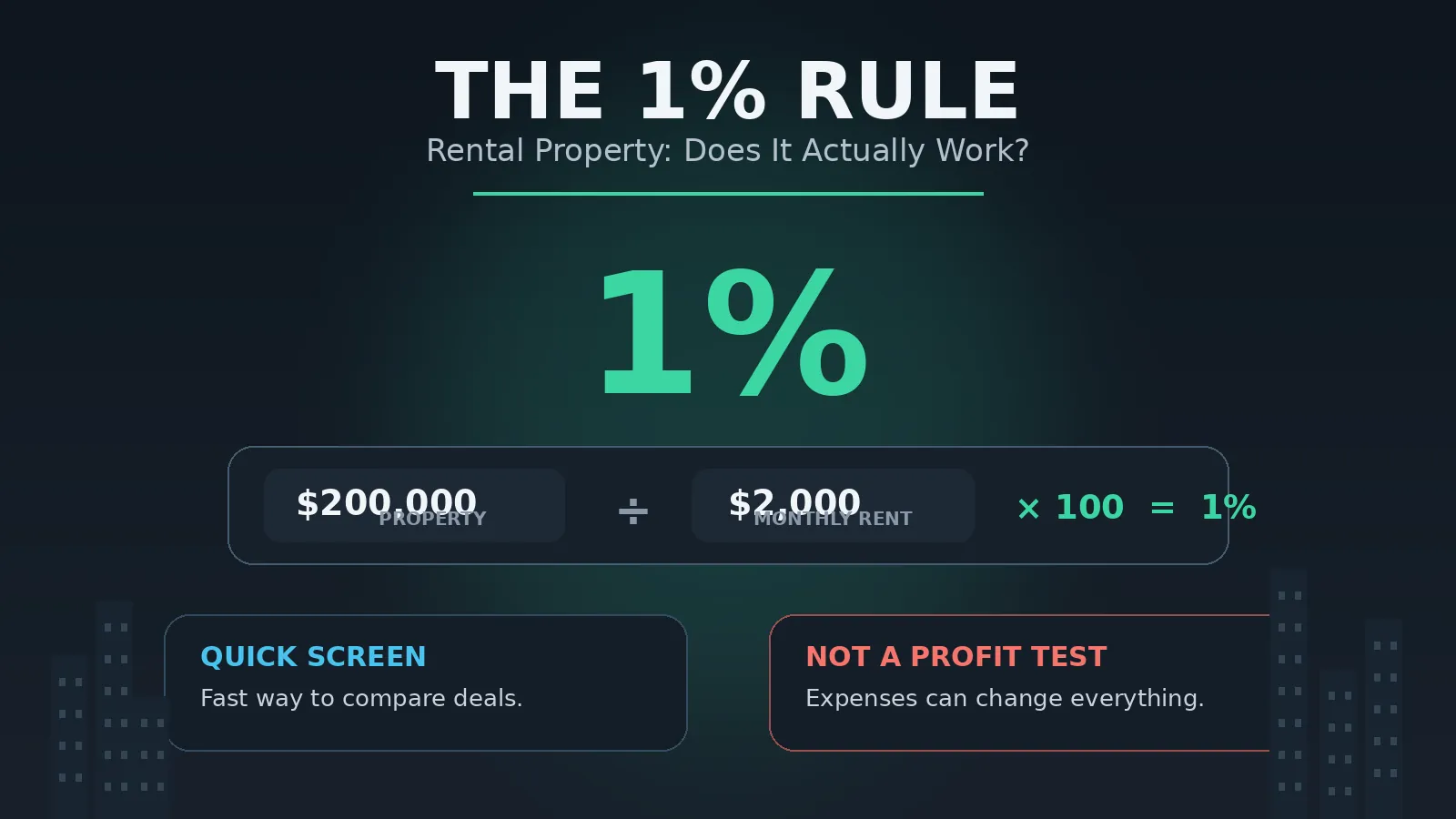
A rental property costs $200,000.
It rents for $2,000 per month.
According to one of the best-known shortcuts in real estate investing, that property passes the 1% rule.
Why?
$2,000 ÷ $200,000 × 100 = 1%
Simple.
Maybe a little too simple.
The 1% rule for rental property can be useful for quickly screening investments, but it does not tell you whether a property will actually make money.
Here is what the rule means, how to calculate it, and where it starts to fall apart.
What Is the 1% Rule in Real Estate?
The one percent rule in real estate compares a property's monthly rent with its purchase price.
The basic idea is:
Monthly rent should be roughly 1% or more of the property's purchase price.
For example:
- $100,000 property → $1,000/month rent
- $200,000 property → $2,000/month rent
- $300,000 property → $3,000/month rent
- $500,000 property → $5,000/month rent
If monthly rent equals at least 1% of the property price, the property "passes" the rule.
But passing the rule does not automatically mean the rental is profitable.
It simply means the rent is relatively high compared with the purchase price.
How to Calculate the 1% Rule
The formula is:
Monthly Rent ÷ Property Cost × 100
Suppose:
Monthly rent: $1,800
Property price: $180,000
Calculation:
$1,800 ÷ $180,000 × 100 = 1%
The property meets the rule.
Now imagine another property with the same $1,800 rent but a price of $300,000.
$1,800 ÷ $300,000 × 100 = 0.6%
Same rent.
Very different result.
That is why the rule can be useful when quickly comparing potential rental properties.
What Rent Do You Need to Reach 1%?
You can reverse the formula too.
For a:
$250,000 property
you would need approximately:
$2,500/month rent
to hit 1%.
For a:
$175,000 property
the target would be:
$1,750/month
A simple 1 percent rule calculator can therefore answer:
"Is the expected rent high enough relative to the purchase price?"
That is useful.
But it is only the beginning of the analysis.
Why Do Investors Use the 1% Rule?
Mostly because it is fast.
Imagine comparing 30 listings.
Instead of calculating every expense for every property, you can quickly screen them.
Property A
$200,000 price $2,100 rent 1.05%
Property B
$250,000 price $1,600 rent 0.64%
Property C
$180,000 price $1,900 rent 1.06%
Properties A and C may deserve a closer look.
Property B is not automatically a bad investment, but its rent is lower relative to its price.
Think of the 1% rule as a filter, not a verdict.
The Big Problem: It Ignores Expenses
The calculation only knows two things:
Property price
and:
Monthly rent
It knows nothing about what the property actually costs to own.
Suppose two properties both cost $200,000 and rent for $2,000/month.
Both score exactly:
1%
But their expenses could look very different.
Property A
- Mortgage: $950
- Tax: $150
- Insurance: $80
- Maintenance: $100
- Management: $150
Estimated cash flow:
+$570/month
Property B
- Mortgage: $1,250
- Tax: $250
- Insurance: $130
- HOA: $300
- Maintenance: $150
- Management: $150
Estimated cash flow:
−$230/month
Both pass the 1% rule.
One makes money.
The other loses money.
That is the limitation.
The 1% Rule Does Not Know About Your Mortgage
Financing alone can completely change a property's performance.
Two landlords could buy identical properties and collect identical rent.
One has cheap financing.
The other has a large mortgage at a higher interest rate.
Their 1% rule result is identical.
Their monthly cash flow may be completely different.
That is why the rule cannot replace a proper rental property cash flow calculation.
It Also Ignores Vacancy
Suppose:
Property price: $200,000
Rent: $2,000/month
Perfect 1%.
But the property sits empty for two months.
Instead of collecting:
$24,000/year
you collect:
$20,000/year
Meanwhile, expenses such as the mortgage, insurance, taxes and service charges continue.
The 1% result has not changed.
Your actual financial performance has.
Repairs Can Change the Picture Too
Imagine another property:
Price: $190,000
Rent: $2,000
Result:
1.05%
Looks promising.
Then you spend:
- $2,000 on plumbing
- $1,500 replacing an appliance
- $1,200 preparing the property between tenants
- $900 on electrical work
That is $5,600 of additional costs.
The rent-to-price ratio still looks excellent.
Your actual cash flow may not.
Does a Property Have to Reach 1%?
No.
A property scoring 0.8% is not automatically bad.
And a property scoring 1.2% is not automatically good.
Suppose a $400,000 property rents for $3,200:
$3,200 ÷ $400,000 × 100 = 0.8%
It fails the traditional rule.
But perhaps it also has:
- Low vacancy
- Low maintenance costs
- Affordable financing
- No management fee
- Strong tenant demand
It could still produce healthy cash flow.
Meanwhile, a 1.1% property with high taxes, expensive financing and frequent repairs could perform worse.
The 1% threshold is a shortcut, not a law.
What Does the 1% Rule Actually Tell You?
It answers one fairly narrow question:
How much monthly rent does this property generate relative to its purchase price?
That can still be useful.
Consider three properties:
| Property | Price | Monthly Rent | Result |
|---|---|---|---|
| A | $250,000 | $1,500 | 0.60% |
| B | $250,000 | $2,200 | 0.88% |
| C | $250,000 | $2,600 | 1.04% |
Property C clearly produces the most rent relative to its price.
That may make it worth investigating first.
But now you need the real numbers.
What Should You Calculate Next?
Once a property passes your initial screening, look at what the 1% rule ignores.
Cash Flow
Rental income − expenses
This tells you how much money the property may actually leave each month.
Cap Rate
Cap rate measures net operating income relative to property value without financing dominating the calculation.
Vacancy
Estimate how periods without tenants affect your annual income.
Maintenance and Repairs
Include realistic allowances for keeping the property running.
Break-Even Rent
Calculate the minimum rent needed to cover your costs.
Cash-on-Cash Return
Compare annual cash flow with the amount of your own cash invested.
Each metric answers something the 1% rule cannot.
The 1% Rule vs Actual Cash Flow
Suppose:
Purchase price: $200,000 Rent: $2,100/month
The property scores:
1.05%
Now look at the monthly costs:
- Mortgage: $1,100
- Tax: $180
- Insurance: $100
- Management: $160
- Maintenance: $150
- Vacancy allowance: $100
- Other expenses: $100
Total expenses:
$1,890
Estimated cash flow:
$2,100 − $1,890 = +$210/month
The 1% rule told you:
"The rent looks strong relative to the purchase price."
Cash-flow analysis told you:
"You may actually keep about $210 per month."
Both are useful.
But they answer different questions.
So, Does the 1% Rule Actually Work?
Yes, if you use it for the right job.
It works well as a quick screening tool.
It can help you compare multiple properties and identify which ones may deserve deeper analysis.
But it should not be treated as proof that a rental property will be profitable.
It ignores:
- Financing
- Taxes
- Insurance
- Vacancy
- Maintenance
- Repairs
- Management
- HOA or service charges
- One-off expenses
And those are exactly the numbers that determine what you actually keep.
Use the 1% Rule as the Starting Line
A sensible approach is:
Step 1
Calculate:
Monthly rent ÷ property price × 100
Step 2
Use the result to decide whether the property deserves a closer look.
Step 3
Calculate the actual income, expenses and cash flow.
Because reaching 1% does not tell you whether a property makes money.
It tells you whether it is worth asking the next question.
The 1% rule gives you a rough answer. Propertira shows you the actual numbers.
→ Calculate Your Rental Property Cash Flow
Use Propertira to enter your property's rent and expenses and see what it may actually leave you every month.
Because a neat percentage is useful.
Knowing what you actually keep is better.
Work it out on your own numbers
Rental cash flow calculator runs this maths for you - enter your rent and costs and see the result straight away. No sign-up needed.\n
- 1 percent rule calculator
- 1% rule rental property
- one percent rule real estate
- rental property cash flow
- rental property investing
Related guides
- Rental Property Payback Period: How to Calculate It (with Examples)The rental property payback period measures how many years it takes for cumulative net cash flow to recover your upfront cash investment. Here is how to calculate it accurately.
- Break-Even Occupancy Rate: How to Calculate It for Rental PropertiesCalculate the exact percentage of the year your rental property must stay occupied to cover all operating expenses and mortgage payments without losing cash.
- Keep or Sell? How to Run the Numbers on an Underperforming RentalDeciding whether to keep or sell an underperforming rental comes down to Return on Equity and opportunity cost. Here is how to run the numbers step by step.
Put this into practice
Use the free calculators with your own figures, or track every property in one place with Propertira.
Propertira provides estimates based on the information you enter. Results are for informational purposes only and are not financial, tax, legal or investment advice.