What Is a Good ROI on a Rental Property? How to Calculate Yours
What is a good ROI on a rental property? Learn how to calculate rental property ROI, compare 3%, 5%, 8% and 10%+ returns, and understand what really affects your investment performance.
A rental property earns $24,000 per year in rent.
Sounds good.
But what if $17,000 disappears into mortgage costs, maintenance, insurance, taxes, management fees, and vacancies?
The number that really matters is not how much rent comes in.
It is how much return you are actually getting from the money you invested.
That is where rental property ROI comes in.
So, what is a good ROI on a rental property?
There is no single number that works for every landlord, but as a simple starting point:
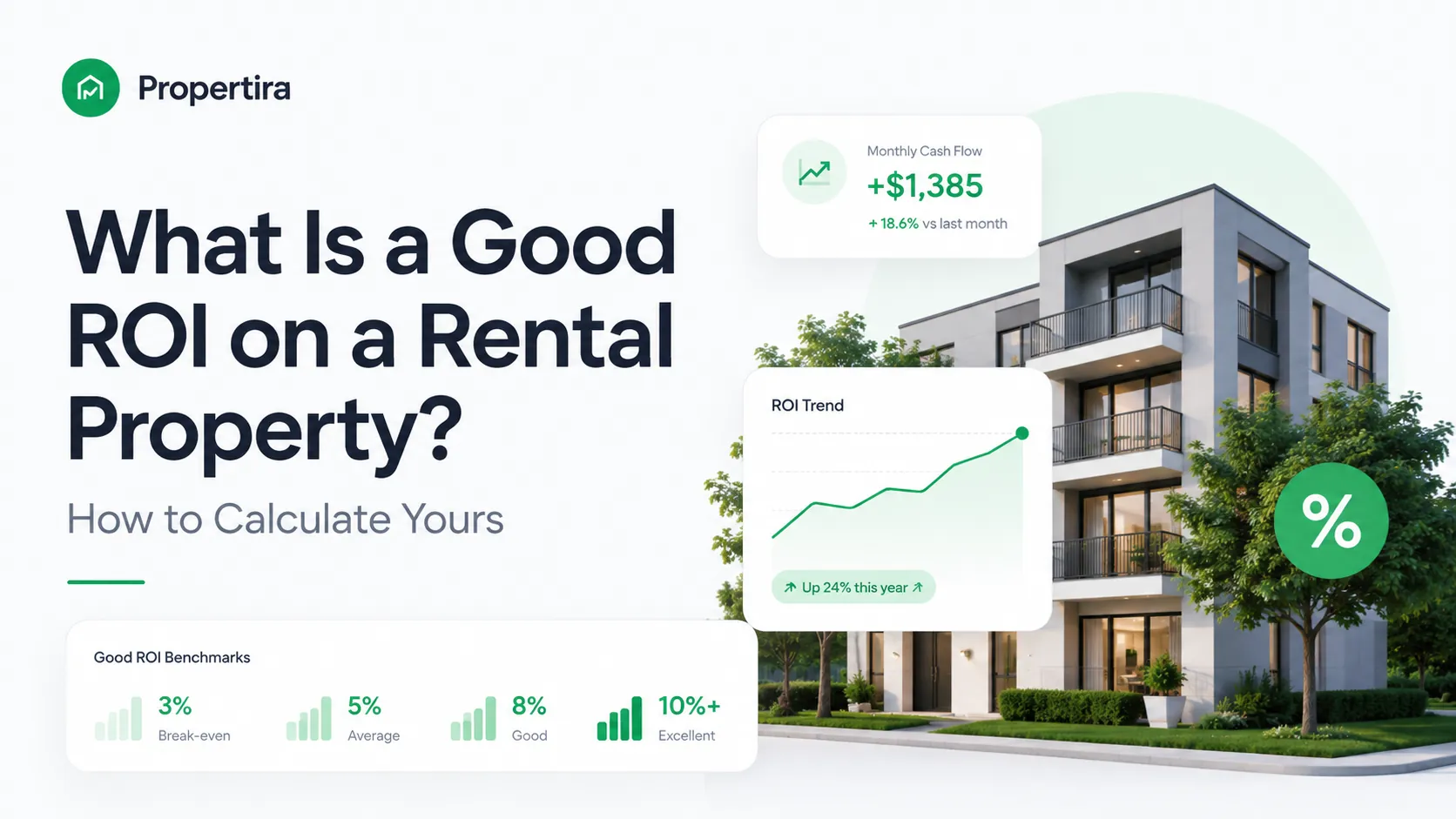
- Around 3% ROI: relatively weak
- Around 5% ROI: reasonable
- Around 8% ROI: strong
- 10%+ ROI: potentially very strong
Those numbers are only rough benchmarks. Financing, property appreciation, taxes, location, risk, maintenance requirements, and your investment strategy can dramatically change whether an ROI is actually "good."
Let's look at how rental property return on investment works, how to calculate yours, and what the number really tells you.
What Is Rental Property ROI?
Rental property ROI, or return on investment, measures how much profit your property generates compared with the amount of money you have invested.
The basic formula is:
ROI = Annual Profit ÷ Amount Invested × 100
For example, imagine you invested $80,000 of your own money into a rental property.
After all relevant expenses, the property generates $6,400 in annual profit.
Your ROI would be:
$6,400 ÷ $80,000 × 100 = 8%
Your rental property ROI is therefore 8% per year.
That means that, based on this simplified calculation, the property produces the equivalent of 8% of your invested capital annually.
What Is a Good ROI on a Rental Property?
A good ROI depends heavily on the property and the investor.
Still, landlords often need a quick benchmark when comparing investments.
A simple framework might look like this:
| Rental Property ROI | General Interpretation |
|---|---|
| Below 3% | Weak return |
| Around 3–5% | Modest |
| Around 5–8% | Reasonable to good |
| Around 8–10% | Strong |
| 10%+ | Potentially very strong |
But this table should not be treated as a universal rule.
An 8% ROI on a relatively stable property in a strong rental market may be excellent.
A 10% projected ROI on a property requiring constant repairs, carrying high vacancy risk, or located in a declining area may be considerably less attractive.
The percentage only becomes useful when you understand what is behind it.
Is 5% a Good ROI on a Rental Property?
A 5% rental property ROI can be perfectly reasonable, especially for a lower-risk property.
Imagine you have invested $100,000 and your property produces $5,000 in annual profit.
Your ROI is:
$5,000 ÷ $100,000 × 100 = 5%
Whether that is attractive depends on factors such as:
- Property appreciation potential
- Financing costs
- Vacancy risk
- Local rental demand
- Maintenance requirements
- How much work the property requires
- Alternative places you could invest the money
A landlord seeking predictable long-term income may be happy with 5%.
Another investor taking substantial risk may expect considerably more.
Is 8% a Good ROI on a Rental Property?
An 8% ROI would generally look much more attractive when the assumptions behind the calculation are realistic.
Suppose you have $75,000 invested in a rental.
Your annual profit after relevant expenses is $6,000.
$6,000 ÷ $75,000 × 100 = 8%
That is a strong-looking return.
But you should still ask:
Does the $6,000 really represent profit?
If you forgot to account for vacancy, repairs, insurance increases, property management, or major future maintenance, the true return could be substantially lower.
This is why tracking actual property performance matters more than relying solely on the return you predicted when buying the property.
Is a 10% ROI on Rental Property Good?
A 10%+ rental property ROI can be very attractive.
For example:
Investment: $60,000 Annual profit: $6,000
$6,000 ÷ $60,000 × 100 = 10%
But unusually high projected returns deserve additional scrutiny.
A higher return can sometimes reflect higher risk.
For example, the property might have:
- Higher tenant turnover
- Greater maintenance requirements
- A weaker location
- Higher vacancy
- Older infrastructure
- More volatile rental demand
- Significant renovation requirements
A 10% return is not automatically better than an 8% return.
You need to compare the return, risk, workload, and long-term prospects together.
How to Calculate ROI on a Rental Property
There are several ways investors calculate property returns.
One simple version is:
Annual Rental Profit ÷ Total Cash Invested × 100
Step 1: Calculate Your Rental Income
Start with the rent you actually expect to collect.
For example:
Monthly rent: $2,000
Annual rental income:
$2,000 × 12 = $24,000
Step 2: Subtract Your Rental Property Expenses
Now calculate what the property costs you.
Expenses could include:
- Property taxes
- Insurance
- Maintenance
- Repairs
- Property management
- HOA or service charges
- Utilities paid by the landlord
- Vacancy losses
- Other recurring operating expenses
Depending on the type of ROI you are calculating, financing costs may also need to be considered.
Imagine the property produces:
$24,000 annual rental income
And you have:
$17,600 in annual costs
Your remaining annual profit is:
$24,000 - $17,600 = $6,400
Step 3: Determine How Much Cash You Invested
Suppose your total cash investment was:
- Down payment: $60,000
- Closing costs: $8,000
- Initial renovation: $12,000
Total cash invested:
$80,000
Step 4: Calculate Your ROI
Now:
$6,400 ÷ $80,000 × 100 = 8%
Your rental property ROI is approximately:
8%
That single number makes it much easier to compare the performance of different properties.
ROI vs Cash Flow: What's the Difference?
ROI and cash flow are closely connected, but they answer different questions.
Cash flow asks:
How much money does this property put in my pocket?
ROI asks:
How good is that profit compared with the money I invested?
Consider two properties.
Property A
Cash invested: $50,000 Annual cash flow: $5,000
ROI:
10%
Property B
Cash invested: $150,000 Annual cash flow: $9,000
ROI:
6%
Property B produces more actual cash.
But Property A generates a higher return relative to the money invested.
That is why looking at only monthly profit can sometimes give an incomplete picture.
You can also use our Rental Property Cash Flow Calculator to estimate how much money your property is actually producing after expenses.
ROI vs Cap Rate
ROI is also different from capitalization rate, commonly called cap rate.
Cap rate typically compares a property's net operating income with its property value:
Cap Rate = Net Operating Income ÷ Property Value × 100
ROI instead looks at your return relative to what you actually invested.
That distinction is particularly important when financing is involved.
Two investors could purchase identical properties but produce very different returns depending on:
- Their down payment
- Interest rate
- Financing structure
- Renovation costs
- Purchase costs
If you want to understand this metric in more detail, read our guide to Cap Rate vs Cash Flow: What's the Difference for Rental Properties?
ROI vs Rental Property Profit Margin
Rental property profit margin asks a slightly different question:
What percentage of my rental income do I actually keep?
Imagine your property generates:
$2,000 per month in rent
After expenses, you keep:
$600
Your profit margin is:
$600 ÷ $2,000 × 100 = 30%
ROI instead compares your profit with the money invested into the property.
Both metrics are useful.
Profit margin shows how efficiently rental income turns into profit.
ROI shows how effectively your invested capital is performing.
You can read our full guide to Rental Property Profit Margin: How Much of Your Rent Do You Actually Keep?
What About the 1% Rule?
The 1% rule is another quick property-screening tool.
It says that monthly rent should be roughly 1% of the property's purchase price.
For example:
Property price: $200,000
Monthly rent: $2,000
That property meets the 1% rule.
But passing the 1% rule does not mean the property has a good ROI.
The property could still have:
- Expensive maintenance
- High property taxes
- Large insurance bills
- Regular vacancies
- High management costs
The 1% rule considers rent and purchase price.
ROI considers the actual return produced by your investment.
That makes ROI much more useful when evaluating the property's real financial performance.
For more detail, see The 1% Rule for Rental Property: Does It Actually Work?
The Biggest Problem With Rental Property ROI
There is one major weakness in almost every ROI calculation:
Your calculation is only as good as your numbers.
Suppose you calculate an 11% projected ROI before purchasing a property.
Excellent.
Then reality arrives.
A tenant leaves unexpectedly.
The property sits empty for six weeks.
The boiler fails.
Insurance increases.
You spend $2,400 on repairs.
Suddenly that beautiful 11% spreadsheet projection becomes something closer to 6%.
This is why landlords should distinguish between:
Projected ROI
and
Actual ROI
Projected ROI helps you decide whether a property might be worth buying.
Actual performance tells you whether the investment is really working.
Don't Forget Vacancy
Vacancy can quietly destroy an otherwise attractive rental return.
Imagine a property renting for:
$2,000 per month
One month without a tenant costs:
$2,000 in lost rental income
Two empty months:
$4,000
If you expected $8,000 annual profit, a two-month vacancy could potentially cut that number dramatically before even considering turnover costs.
A property with a slightly lower theoretical ROI but reliable occupancy can sometimes outperform a supposedly higher-return property with frequent vacancies.
Don't Forget Maintenance Either
Maintenance is another reason projected ROI often looks better than reality.
Your rental might generate excellent cash flow for six months.
Then:
- Appliance replacement: $900
- Plumbing repair: $650
- Painting between tenants: $1,200
- Minor electrical repairs: $400
That is $3,150 in costs.
If you only look at rent collected, your property may appear highly profitable.
Once the expenses are included, the picture changes.
Appreciation Can Change the Calculation
Rental properties can potentially generate returns in more than one way.
You may receive:
- Rental income
- Property appreciation
- Mortgage principal reduction, if financed
Suppose you earn 6% from rental operations while the property's value also increases.
Your total economic return could therefore be greater than the rental ROI alone suggests.
However, appreciation is not guaranteed.
Property values can stagnate or fall.
For landlords primarily interested in sustainable cash generation, it can be useful to evaluate rental performance independently rather than relying on future appreciation to make a weak property look attractive.
Financing Can Dramatically Change ROI
Leverage can make rental ROI particularly interesting.
Imagine two landlords buy identical $250,000 properties.
Investor A
Pays $250,000 cash.
Investor B
Invests $75,000 cash and finances the rest.
Even if both properties produce the same operating income, their return on the actual cash invested can look very different.
Leverage can amplify returns.
It can also amplify risk.
Mortgage payments continue even when:
- A tenant stops paying
- The property is vacant
- Repairs are required
- Rental income falls
So a higher leveraged ROI is not automatically a safer or better investment.
Average Rental Property ROI Isn't Everything
People frequently search for the average rental property ROI because they want a benchmark.
That makes sense.
But averages can be misleading.
A rental property in one market could have:
- Higher appreciation
- Lower rental yield
- Low vacancy
Another could have:
- Little appreciation
- High rental yield
- Higher maintenance and vacancy risk
Comparing the two purely through a nationwide or market-wide average can hide these differences.
A better question is:
Is this property's return good enough for the risk, capital, and effort involved?
That is ultimately what matters.
Track ROI Over Time, Not Just When You Buy
One of the most useful things a landlord can do is stop treating ROI as a calculation made once.
Your property's financial performance changes.
Rent increases.
Expenses increase.
Mortgage costs may change.
Maintenance varies.
Vacancies happen.
Property management fees change.
The property that looked excellent three years ago might now be underperforming.
And a property that originally looked average may become highly profitable as rents rise.
Track the numbers over time.
Know What Your Rental Actually Makes
A landlord might receive $3,000 every month in rent and feel like the property is performing brilliantly.
But rent collected is not profit.
The useful numbers are what remain after the property has absorbed its costs.
That is exactly the problem Propertira is designed to make easier.
Instead of trying to remember everything across spreadsheets, bank statements, and notes, you can track your properties, rent, expenses, and monthly cash flow in one place.
The goal is simple:
Know if your rentals actually make money.
Because ultimately, the best rental property is not necessarily the one collecting the most rent.
It is the one producing a return that makes sense for the money, time, and risk you have invested.
Frequently Asked Questions
What is considered a good ROI on a rental property?
There is no universal target, but an ROI of roughly 5–8% may represent a reasonable to strong return in many situations, while 10%+ can look particularly attractive. The appropriate return depends on risk, financing, location, maintenance, appreciation potential, and investment goals.
Is 5% ROI good for rental property?
A 5% ROI can be reasonable, especially for a relatively stable, lower-risk property. Whether it is attractive depends on the alternatives available to the investor and the property's long-term prospects.
Is 8% ROI good for a rental property?
An 8% ROI can be a strong result if the calculation accurately accounts for expenses, vacancy, maintenance, and the total cash invested.
Is 10% rental property ROI good?
A 10%+ ROI can be very attractive, but investors should investigate why the return is high. Higher projected returns can sometimes come with higher vacancy, maintenance, financing, or location risk.
How do you calculate rental property ROI?
A simplified formula is:
Annual Rental Profit ÷ Total Cash Invested × 100
For example, if your property produces $8,000 in annual profit and you invested $100,000, the ROI would be 8%.
What is the difference between ROI and rental yield?
Rental yield generally compares rental income with a property's value, while ROI compares the return generated with the amount of capital invested. ROI can therefore provide a more personalized picture of an individual investor's performance.
Should appreciation be included in rental property ROI?
It can be included when calculating total investment return, but many landlords find it useful to examine operating or cash returns separately. Appreciation is uncertain, while rental income and expenses show how the property is performing today.
Final Takeaway
So, what is a good ROI on a rental property?
As a simple starting framework:
3% → Weak
5% → Reasonable
8% → Strong
10%+ → Potentially very strong
But there is no magic percentage.
A good rental property return on investment is one that compensates you appropriately for the capital, risk, financing, work, and uncertainty involved.
And don't rely only on the ROI you calculated when you bought the property.
Track what actually happens.
Rent minus real expenses tells a much more interesting story than rent alone.
Work it out on your own numbers
Rental property profit calculator runs this maths for you - enter your rent and costs and see the result straight away. No sign-up needed.\n
Related guides
- Rental Property Profit and Loss (P&L) Statement: A Practical Landlord GuideA rental property profit and loss (P&L) statement tracks your real revenue against actual operating costs. Here is how small landlords can build, read, and analyze one.
- Rental Property Payback Period: How to Calculate It (with Examples)The rental property payback period measures how many years it takes for cumulative net cash flow to recover your upfront cash investment. Here is how to calculate it accurately.
- Break-Even Occupancy Rate: How to Calculate It for Rental PropertiesCalculate the exact percentage of the year your rental property must stay occupied to cover all operating expenses and mortgage payments without losing cash.
Put this into practice
Use the free calculators with your own figures, or track every property in one place with Propertira.
Propertira provides estimates based on the information you enter. Results are for informational purposes only and are not financial, tax, legal or investment advice.