Best Free Tools for Landlords in 2026 (and Where They Fall Short)
A fair roundup of the best free landlord tools in 2026 — rent collection, screening, and expense tracking — plus where "free" tends to run out as you scale.
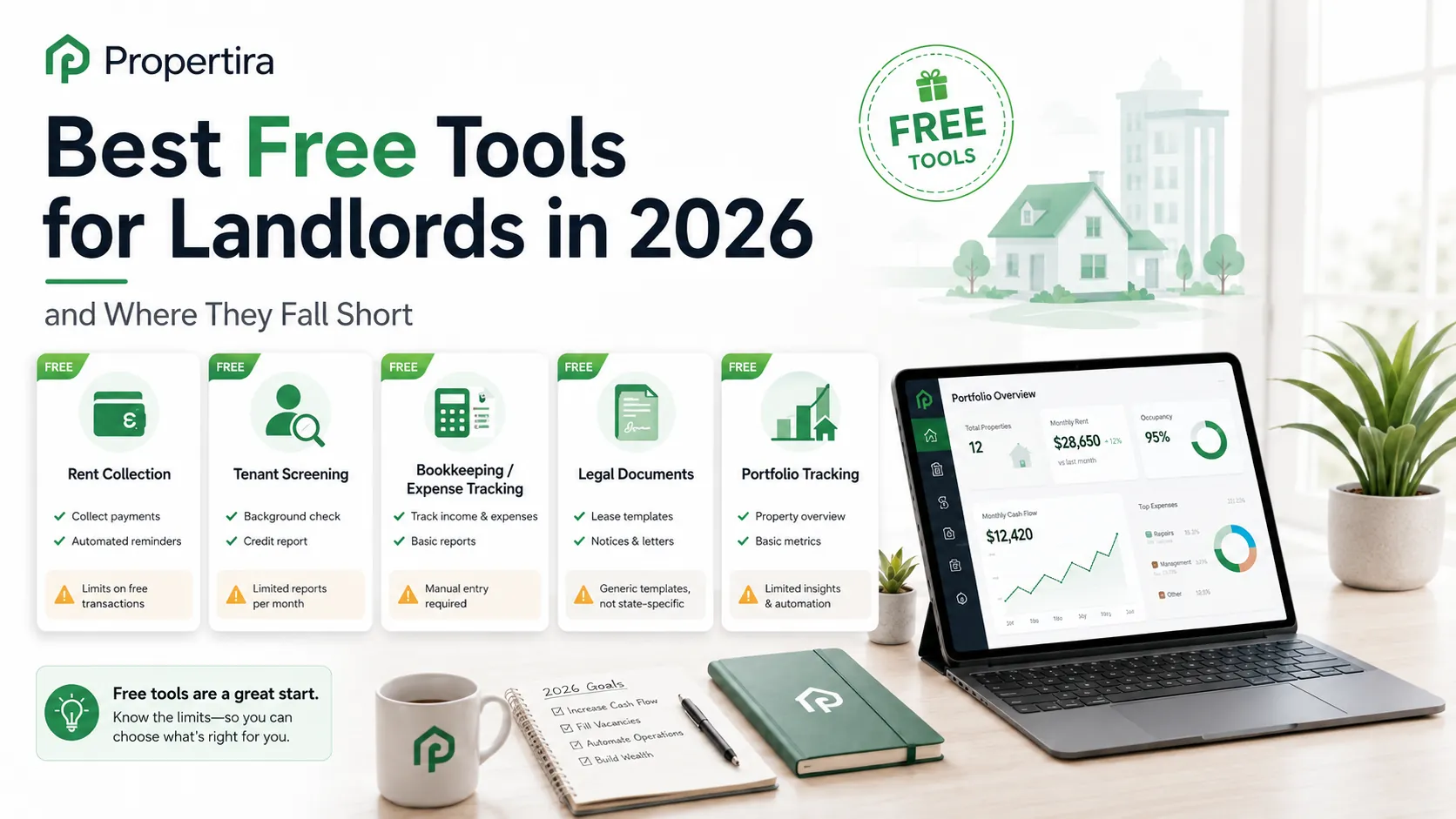
You don't need to spend money to run a rental property properly, at least not at first. Between free rent collection apps, free tenant screening, and free spreadsheet templates, a self-managing landlord with one or two units can build a genuinely solid setup without paying for anything.
This is a fair, practical look at the best free landlord tools available in 2026, organized by the job each one does — and an honest look at the point where "free" tends to run out of road as a portfolio grows.
Rent collection
TurboTenant and Avail both offer free plans that cover online rent collection with ACH transfers, automatic payment reminders, and a payment history log — genuinely useful for landlords who want tenants paying digitally without taking on a monthly software bill.
Zelle (or a similar bank-to-bank transfer app) is the simplest free option if your tenants are already comfortable using it. There's no platform fee and transfers are close to instant, but you lose the automatic receipts, payment history, and reminders that a dedicated rent collection tool provides.
Where it falls short: these tools track that rent was paid, but not what that rent actually left you with once costs came out. Payment history isn't the same as a cash flow picture.
Tenant screening and listings
TurboTenant, Avail, and Innago all offer free tenant screening, with credit, criminal, and eviction history checks. In most cases the cost of the report is passed to the applicant rather than charged to you, so screening ends up free at the point of use for the landlord. The same platforms typically bundle in free rental listing syndication, application forms, and basic lease templates.
Zillow Rental Manager is another free option specifically for listing reach, useful if you're trying to fill a vacancy quickly without paying for premium placement.
Where it falls short: these are one-time or occasional tools tied to finding and vetting a tenant. They don't help with the ongoing, monthly side of running a rental — income, expenses, and whether the property is actually profitable.
Bookkeeping and expense tracking
Stessa offers a free tier built specifically for rental property owners, with bank account linking, automatic transaction categorization, and Schedule E-ready reports at tax time. For a landlord who wants their expense tracking connected directly to their bank, this is one of the more capable free options available.
Google Sheets and Excel templates remain the other major free route — a rental income and expense spreadsheet you build yourself, or a landlord spreadsheet template downloaded from a state landlord association or real estate blog. These give you full control over categories and layout, at the cost of having to build and maintain the structure yourself. (We've written a full comparison of rental property spreadsheets vs dedicated trackers if you're weighing that choice.)
Where it falls short: bank-linked free tiers often cap out at a small number of connected accounts or properties before prompting an upgrade, and spreadsheets — as covered in that comparison — get harder to maintain accurately once you're tracking several properties with monthly history.
Legal documents and compliance
Most state and regional landlord associations publish free or low-cost lease templates, notices, and required disclosure forms that comply with local law. These are worth using directly from the source rather than a generic template site, since requirements vary meaningfully by location.
Where it falls short: free templates cover the document itself, not ongoing compliance tracking — renewal dates, notice deadlines, or required inspections across multiple properties still need to be tracked somewhere.
Where free tools tend to run out
Free landlord tools are genuinely good for what they're built for: filling a vacancy, screening a tenant, collecting rent, or filing taxes. Where landlords typically start hitting limits is the ongoing, month-to-month question of profitability — and a few patterns show up repeatedly:
- Bank-linked free tiers cap out. Most free bookkeeping tools limit how many accounts or properties you can connect before nudging you toward a paid plan.
- Portfolio comparison isn't the job these tools were built for. Rent collection and screening tools are built around a single property or tenant at a time, not a side-by-side view of how five properties are performing against each other.
- Free spreadsheet templates inherit every spreadsheet limitation. Manual totals, formula risk, and the effort of maintaining monthly history across multiple tabs — all still apply, template or not.
- "Free" often means free until a specific point. A free plan capped at one property, or free until you want a report, is common — worth checking before you build your whole workflow around it.
None of this makes free tools a bad starting point — quite the opposite. It just means the free tier for most platforms was built to get you started, not to be the system you run a growing portfolio on indefinitely.
Where Propertira fits in
Propertira isn't trying to replace your rent collection app or your screening tool — it's built specifically for the piece those tools don't cover: knowing what each property, and your portfolio as a whole, actually puts in your pocket each month.
You enter rent and expenses per property, and Propertira handles the monthly history, per-property comparisons, and per-property currency automatically — without a bank connection requirement, a spreadsheet to maintain, or a cap on how many properties you can meaningfully compare. If you're using free tools for collection and screening already, Propertira is designed to sit alongside them as the profitability layer.
[Start tracking free →](https://propertira.com)
FAQ
Are free landlord tools actually free, or is there a catch? It depends on the tool. Some are genuinely free for landlords because the cost is passed to the tenant (like screening report fees). Others offer a free tier capped at one property or a limited feature set, with paid plans for anything beyond that — worth checking the specifics before relying on one.
What's the best free tool for tracking rental income and expenses? Stessa's free tier is a solid bank-linked option, and a well-built rental property spreadsheet is the other common free route. Both work well for one or two properties; both get harder to rely on as a portfolio grows.
Do I need paid software to manage a couple of rental properties? Not necessarily. For one or two properties, free rent collection, screening, and expense tracking tools can cover most of what you need. The case for paid tools tends to build as you add properties and need reliable, ongoing comparison between them.
Can I mix free tools with a paid tracker? Yes — many landlords use free tools for rent collection and tenant screening, and a dedicated tracker like Propertira specifically for cash flow visibility across their properties, rather than replacing every tool with one platform.
Work it out on your own numbers
Rental property profit calculator runs this maths for you - enter your rent and costs and see the result straight away. No sign-up needed.\n
- free landlord tools
- free property management tools
- free rental property tracker
- landlord software 2026
- rental property bookkeeping
Related guides
- The Landlord's Guide to Tracking Multiple Rental PropertiesTracking multiple rental properties gets messy fast. Here's a practical structure for managing them properly — and how to spot the one quietly losing you money.
- Rental Property Spreadsheet vs Property Tracker: Which Is Better?Your rental property spreadsheet was perfect for one property. Here's why it starts to break down as your portfolio grows — and what a landlord tracker does differently.
- How to Calculate Prorated Rent: Formulas, Methods, and Real ExamplesProrated rent adjusts monthly rent to reflect only the days a tenant actually occupies a property. Here is how to calculate it using the three most common landlord methods.
Put this into practice
Use the free calculators with your own figures, or track every property in one place with Propertira.
Propertira provides estimates based on the information you enter. Results are for informational purposes only and are not financial, tax, legal or investment advice.