The Landlord's Guide to Tracking Multiple Rental Properties
Tracking multiple rental properties gets messy fast. Here's a practical structure for managing them properly — and how to spot the one quietly losing you money.
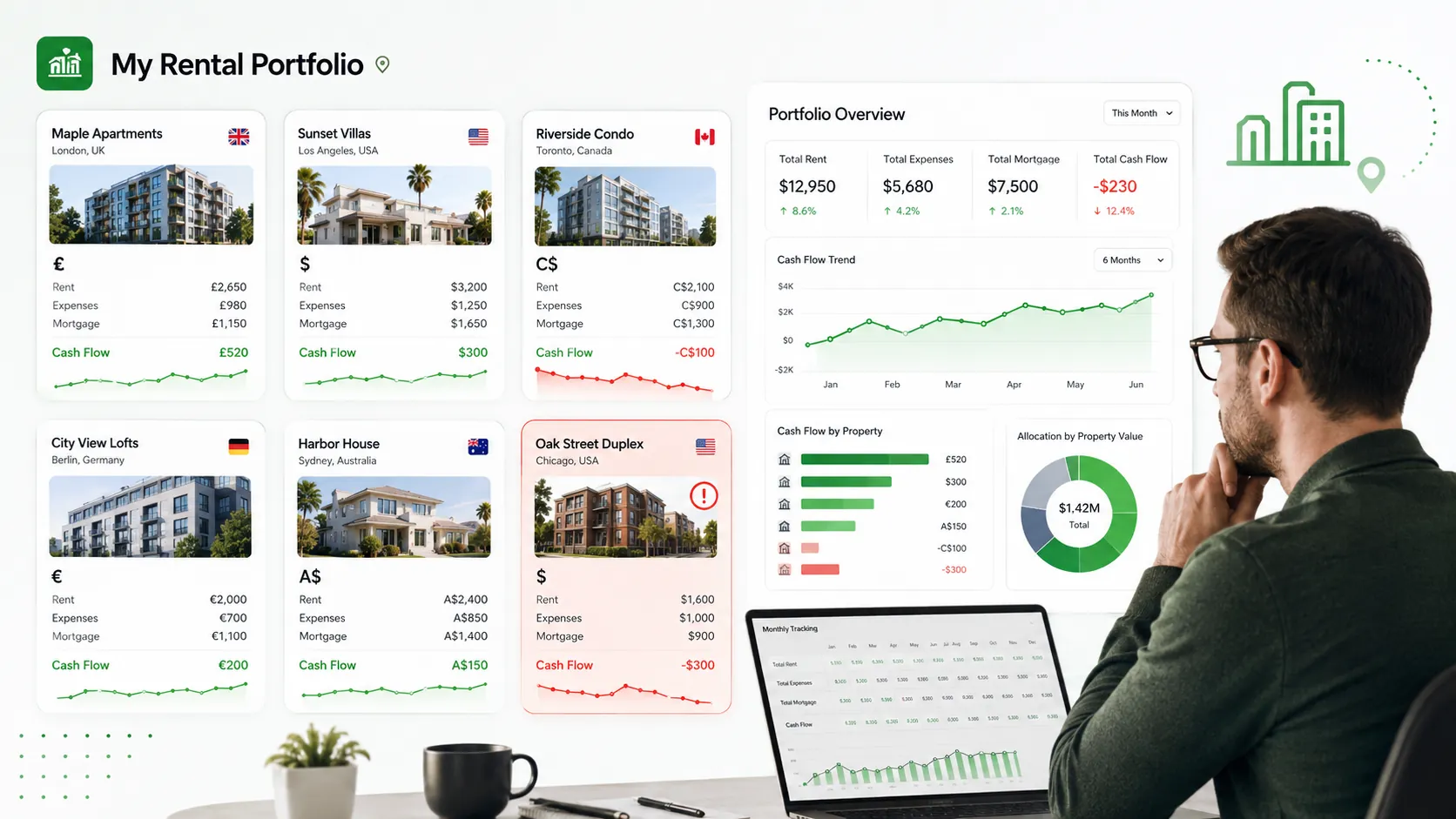
Owning one rental property is a side project. Owning three, five, or ten is a small business — and it needs to be tracked like one. If you've gotten to the point where you're juggling separate records for each property and still can't answer "which one is actually making me money right now" without pulling out a calculator, this guide is for you.
This isn't about convincing you that tracking multiple rental properties is harder than tracking one — you already know that. It's about the specific things that break as your portfolio grows, and a practical structure for tracking that scales past two or three properties without falling apart.
What actually gets harder with multiple properties
It's not just "more work." A few specific problems show up that don't exist when you own a single property:
You can't see your worst performer at a glance. With one property, you know instantly whether it's doing well. With five, one property can be quietly losing money for months while the others mask it in a combined total.
Costs stop being uniform. Different mortgages, different insurance, different management arrangements, different local costs if properties are in different areas or countries. A tracking method built for one property rarely holds up once every property has its own cost structure.
History becomes as important as the current snapshot. A single month's numbers tell you very little on their own. What matters is the trend — is this property's cash flow improving or slowly eroding? That only shows up when you're tracking consistently over time, not just checking in occasionally.
Currency and location can vary. If your properties aren't all in the same country, comparing them by raw numbers alone is misleading. A €600 profit and a $600 profit aren't the same thing, and manual conversion adds a step most landlords skip — which means comparisons quietly become inaccurate.
Manual totals don't scale. Adding up five properties by hand once a month is manageable. Doing it every month, indefinitely, while also trying to catch errors, is where most tracking systems for multiple properties start to fail.
A structure that holds up as you add properties
Whatever tool you use — spreadsheet, tracker, or otherwise — the underlying structure matters more than the tool itself. Here's what a system built for multiple properties needs to do:
1. Track each property individually, but roll up automatically
Every property needs its own record: its own rent, its own expenses, its own mortgage. But you should never have to manually add those up to see your total portfolio position. If updating one property means also updating a separate "totals" section, that's a step that will eventually get missed.
2. Keep a consistent expense structure across every property
Rather than letting each property develop its own ad-hoc list of expense categories, use the same categories everywhere — maintenance, management fees, insurance, mortgage, void periods. This is what makes side-by-side comparison possible. If one property calls it "repairs" and another calls it "maintenance," you can't compare them cleanly.
3. Record monthly, not "eventually"
The value of tracking multiple properties compounds over time. A single month of data tells you almost nothing about a property's real performance; twelve months of consistent data tells you everything — seasonal patterns, whether costs are creeping up, whether a property is actually worth keeping. Monthly recording is the habit that makes the rest of this useful.
4. Normalize currency if your properties aren't all in one place
If you own property across borders, decide on either a single reporting currency for comparison purposes, or a system that converts automatically. Comparing properties in their raw local currency will eventually lead you to the wrong conclusion about which one is actually your best performer.
5. Review at the portfolio level, not just property by property
Set a regular time — monthly or quarterly — to look at every property side by side, not just each one in isolation. This is usually where landlords first notice a property that's been drifting into negative cash flow while attention was elsewhere.
Where this breaks down in a spreadsheet
Most landlords start building exactly this structure in a spreadsheet — a tab per property, a summary tab that pulls totals together. It works, right up until it doesn't:
- The summary tab formulas reference the wrong row after someone inserts a line in a property tab
- A new property means copying a tab and manually fixing every formula that copy carries over
- Currency conversion has to be updated by hand and quietly goes stale
- Monthly history means the sheet keeps growing sideways or downward until it's unwieldy to navigate
None of this is a failure on the landlord's part — it's the natural ceiling of a tool built for flexibility, not structure. For one or two properties, that ceiling is high enough to never matter. For five, ten, or more, it's usually the reason landlords start looking for something purpose-built.
How Propertira handles this
Propertira is built around exactly the structure above, without the manual maintenance. Each property gets its own record with rent, running costs, and mortgage, and your portfolio total updates automatically — no summary tab to keep in sync. Expense categories stay consistent across every property so comparisons are meaningful, monthly history is kept automatically rather than something you have to remember to save, and each property can be tracked in its own currency without manual conversion.
The result is the same one clear number you'd want from a well-built spreadsheet — cash flow per property and across your portfolio — without the risk of a broken formula quietly throwing off your numbers, and without rebuilding your structure every time you add a property.
[Start tracking free →](https://propertira.com)
FAQ
What's the biggest mistake landlords make when tracking multiple properties? Letting expense categories drift between properties, so nothing lines up cleanly for comparison, and only reviewing performance property-by-property instead of side by side.
How often should I review multiple rental properties? Monthly for recording, and at least quarterly for a proper side-by-side review across your whole portfolio — that's usually when an underperforming property becomes obvious.
Do I need separate tracking for properties in different currencies? You need a system that either normalizes to one reporting currency or tracks each property in its own currency and lets you compare accurately — raw, unconverted numbers will give you a misleading picture.
At what point does a spreadsheet stop working for multiple properties? There's no fixed number, but most landlords feel the strain around three to five properties, when manual totals, formula errors, and inconsistent expense categories start costing more time than they save.
Three ways to track rental income and expenses
Whatever the portfolio size, most landlords end up with one of three systems:
- Spreadsheets (Excel or Google Sheets). Free and endlessly customisable, but entirely manual: every receipt is typed in, and a broken formula can quietly distort a whole year.
- General accounting software. Powerful for a business, heavy for a landlord, and usually missing per-property rental metrics like cash flow, yield or break-even rent.
- A dedicated rental tracker. Built around properties rather than ledgers, with ready-made expense categories, per-property currency and a clear monthly net figure.
What to record every month
Consistency matters more than the tool. For each property, capture:
- Rent collected - the gross figure, including pet, parking or storage payments.
- Mortgage - keep principal and interest separate from any tax or insurance escrow.
- Maintenance and repairs - log each fix the day it happens, however small.
- Management fees - the recurring percentage plus one-off letting or renewal fees.
- Landlord-paid utilities - water, waste, communal electricity.
- Vacancy reserve - a share of the rent set aside for empty months.
- Insurance and property tax - the fixed overheads, whether paid directly or through escrow.
- One-off costs - legal notices, assessments, advertising.
- Monthly cash flow - income minus every cost above, which is the number that tells you whether the property works.
Once those nine lines are recorded the same way every month, comparing properties becomes trivial - and you can check the maths against the cash flow calculator any time.
- landlord portfolio management
- managing multiple rental properties
- rental property cash flow
- rental property tracker
- track multiple properties
Related guides
- Best Free Tools for Landlords in 2026 (and Where They Fall Short)A fair roundup of the best free landlord tools in 2026 — rent collection, screening, and expense tracking — plus where "free" tends to run out as you scale.
- Rental Property Spreadsheet vs Property Tracker: Which Is Better?Your rental property spreadsheet was perfect for one property. Here's why it starts to break down as your portfolio grows — and what a landlord tracker does differently.
- Net Effective Rent: How to Calculate True Income After Tenant ConcessionsContract rent numbers can be deceiving when concessions are involved. Here is how to calculate your net effective rent and evaluate the true monthly cash-flow impact of tenant incentives.
Put this into practice
Use the free calculators with your own figures, or track every property in one place with Propertira.
Propertira provides estimates based on the information you enter. Results are for informational purposes only and are not financial, tax, legal or investment advice.